
REVIEW · CáDIZ TOURS FROM SEVILLE
Cadiz: City Walk with Audio Guide in 7 Languages on your Phone
Cadiz has a knack for pulling you in fast. This self-guided phone audio walk turns a simple stroll into a guided route through the city’s best-known landmarks, with GPS help and audio in 7 languages. I like that it starts right at the heart of town, and that you can pace it yourself instead of being rushed by a group schedule. One thing to consider, though: the narration may feel more like automated audio than a human guide, and you should expect the walk to take longer than the headline timing.
Two big wins for me are the practical flow of the route and the range of sights you hit without tickets driving your day. You pass major highlights like the Cathedral of Cádiz with its famous golden dome, and also stop by places such as the Teatro Romano de Cádiz and the Castle of San Sebastián area. The main drawback is simple planning, charge your phone fully and bring a power bank, because you are relying on both internet and GPS.
If you want a low-cost way to orient yourself and still feel like you are seeing the right stops, this is a good fit. Just go in knowing you are doing a walking, phone-led experience, not a full-service guided tour with lots of extra chatting along the way.
Key highlights before you start
- GPS guidance on your phone so you can find the next stop without constant map hunting
- Audio guide in 7 languages with 27 stories built into the route
- A tight route of about 6.6 km that connects major Cádiz sights on foot
- Cathedral dome and maritime vibe are central themes along the way
- Ancient to fortress to city squares in one continuous walk
- It can run long in real time, so build in extra time for breaks
Entering Cádiz from Plaza Catedral, then letting GPS lead
The walk begins at Plaza Catedral, right in the thick of the old-city core. That matters because you are not spending your first 20 minutes figuring out where you are supposed to be. Once you start, you follow the route at your own speed while the app handles the “where next” part through GPS guidance.
The whole format is simple: you load the audio guide on your phone, then press play when the route prompts you. You also get the flexibility of a built-in story structure, since there are 27 stops/stories across roughly 2 to 3 hours of walking time. In practice, I’d plan on a little extra time for the moments where you slow down, look around, or step aside to catch a view.
One practical note, you do need your phone and you need it ready. The experience requires an internet connection and GPS function, and headphones are not included. If your battery is low, this is the kind of tour that can turn into frustration fast, so charge up ahead of time.
You can also read our reviews of more tours and experiences in Cadiz.



Price and value: $9.01 for a self-guided route that hits the big names

At $9.01 per person, the price is hard to argue with, especially because what you are paying for is not museum entry. Admission fees for attractions are not included, which keeps the cost down, but it also means you should treat this as orientation plus storytelling, not as a ticket bundle.
For value, the key is that you get:
- an app with audio in 7 languages
- GPS guidance
- a walk that covers multiple major sights without needing transport
If you like to walk, this is a cost-efficient way to experience Cádiz in a structured way. You are paying for guidance, not for access. The app helps you connect the dots between buildings and neighborhoods, so the city feels less like random streets and more like a route with meaning.
Also, the experience is set up as private for your group, which is a small but real benefit. You are not sharing headphones, not listening over chatter from strangers, and you can pause when you want to without feeling like you are holding anyone back.
Cathedral of Cádiz: the golden dome and the sea-linked identity
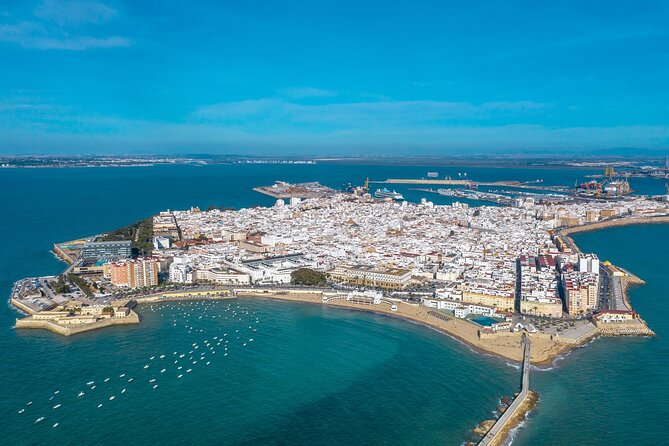
The Cathedral of Cádiz is one of the anchors of the walk, and the audio guidance spends time on why it looks the way it does. It’s built over centuries, so you see a mix of Baroque and Neoclassical influences. That blending is important, because it tells you that Cádiz was not static. It kept changing as the city grew and as different eras left their marks.
The headline feature is the golden-tiled dome, which is tied to the nickname Catedral de la Santa Cruz sobre el Mar (Cathedral of the Holy Cross upon the Sea). Even if you have never learned the specific symbolism, the nickname alone gives you a clue: this cathedral is meant to connect with the ocean-facing life of the city.
Inside, the tour story points out that you can explore chapels with artwork, sculptures, and stained glass. There’s also mention of the crypt, where the remains of notable figures from Cádiz’s history are kept. Two things to keep in mind:
- This audio walk does not include admission, so if you want to go in, you’ll need to budget time for potential ticketing and follow the cathedral’s rules.
- If you have only a short window, you can still get a lot from the exterior and the surrounding area, because the dome and cathedral setting do most of the work for you.
Teatro Romano de Cádiz in El Populo: where old stones still matter
Another highlight on the route is the Romano Theatre of Cádiz, located in the El Populo district, just east of the main cathedral. You’re not just hearing that it exists, you learn that the remains were discovered in 1980, which gives you a sense of how recent some of this “ancient city” visibility actually is.
The story also connects the theatre to its deeper timeline. It is believed to have been built in the 1st century BC, and it was excavated by order of King Alfonso X of Castile. That detail helps you see the theatre not as a lonely ruin, but as something that modern Cádiz chose to uncover and preserve.
Practical tip: when you reach the theatre area, take a slow lap around the immediate streets before you settle. Even if you cannot see every structure from one angle, the urban setting gives context. Roman remains can feel abstract, but in a living neighborhood like this, the scale and location become easier to understand.
Plaza de San Juan de Dios and Arco del Pópulo: the city’s natural meeting points
Squares are where Cádiz stops feeling like “a sightseeing list” and starts feeling like a real place. Plaza de San Juan de Dios is one of those squares on the route. The audio explains it’s been a main square for centuries and that it sits near one of the city gates, the Arco del Pópulo.
Why this matters: you’re not just walking past an open space. You’re arriving at the kind of place locals use as a reference point. When you know a square’s job in the city, it’s easier to understand why certain streets and landmarks line up the way they do.
This is also a good “reset stop.” If you are timing yourself, this is where you can step into the square, grab water, and decide whether you want to keep going at a steady pace or slow it down. Since the route includes many stories, those little breaks help you avoid the phone fatigue that can happen when you’re listening nonstop.






La Caleta and the Castle of San Sebastián: fortress views at the edge of town
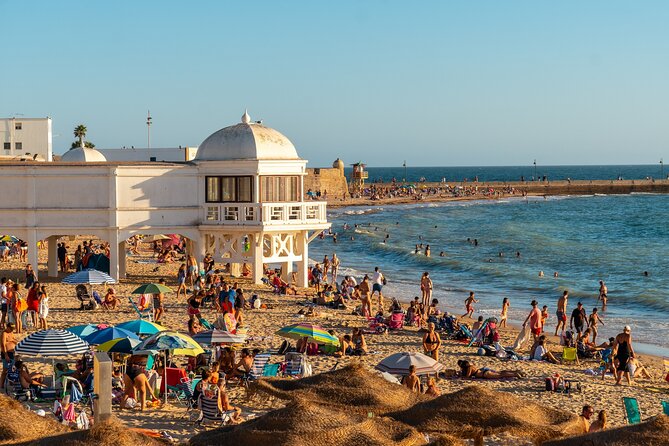
The route also heads toward the Castle of San Sebastián, described as a fortress in Cádiz located at the end of La Caleta Beach on a small island. Even without deep technical history in the audio, the location tells you the purpose: coastal defense, sightlines, and control of movement along the water.
If you like photogenic viewpoints, this is one of the places where you can pause and just watch the sea-facing edges. The audio walk’s strength is that it connects monuments to setting, and this stop is all about that relationship between city and ocean.
Keep in mind, because you are walking, you are managing time and energy. When you reach the beach edge area, take a moment to assess your pace. If you are running behind, you may want to skim the audio at a faster speed and save the deeper listening for a quieter square.
Torre Tavira and Parque Genovés: breaks and viewpoint energy
The route also includes stops that many people love for atmosphere, even if you only catch them from street level. Torre Tavira is listed among the impressive sights on the tour route, and Parque Genovés is also included.
What I like about having places like these on the route is that they break up the heavier monument segments. Cathedrals and theatres pull your attention toward stone and architecture. A park and a tower shift your brain back to views, shade, and breathing room.
The audio won’t replace actually wandering slowly here, so if you enjoy pauses, treat these as places to slow down for a few minutes. If you are short on time, focus on the audio and then do a quick look rather than a long break.
Real timing: why 2 to 3 hours can become longer

The walk is described as 2 to 3 hours (approx.) with about 6.6 km of walking. It’s also built from 27 stories, so you have more audio content than a quick “point and go” route.
In real life, the gap between the headline timing and your actual experience can come down to how often you pause. If you stop for photos, if you enter any locations even briefly, or if you just enjoy reading the scenes, you may stretch beyond the 3-hour mark.
The good news is flexibility: you can finish it by the end of the next day. That means you can break the day into chunks. Start, listen, walk for an hour or two, then come back later to finish. This is a big deal if you are traveling with a packed schedule or if you are waiting to check in at your hotel.
My suggestion: plan your start so you are not rushing into dinner right after. You’ll enjoy it more if you treat it like a guided stroll, not a workout.
Headphones, battery, and the internet-GPS combo
This experience is powered by your phone, so your setup is part of the tour quality.
Here’s what you should prepare:
- Bring headphones (not included)
- Use a phone with internet connection and GPS working
- Charge your phone to the max or carry a power bank
- Consider downloading anything you can ahead of time, but note that the experience requires internet and GPS function
If your battery dies mid-walk, you can end up stuck without the next cues. And if GPS is spotty, the app can feel less helpful even if you are still walking in the right general area.
One more small but important habit: keep your screen brightness low enough to preserve battery, and resist the urge to keep checking maps. Let the app guide you and save your energy for enjoying the city.
Who this walk is best for
This is a strong match if you want:
- a structured route without the pressure of a meeting time later
- a budget-friendly way to get oriented in Cádiz
- audio in 7 languages if you’re traveling with friends who want different language options
- a self-paced stroll where you can stop at squares and viewpoints
It’s also a good “in-between time” activity. If your day starts earlier than your hotel check-in, you can use it to get out and see key sights while you wait.
If you dislike phone-based narration, or if you strongly prefer a human guide with richer back-and-forth commentary, you might feel this is less engaging than a live tour. The narration can feel automated, and some people want more talk per stop. That’s the main trade-off: you get structure and low cost, but you give up the personality you’d hear from a person.
Should you book this Cádiz audio walk?
Book it if you want an affordable, practical way to connect Cádiz’s landmarks into a single walking route. The Cathedral’s golden dome, the Teatro Romano, and the Castle of San Sebastián area give you three anchors that make the whole city make sense faster than wandering without a plan.
Skip it or think twice if you want heavy storytelling depth or a human voice style. Also, if you know you walk slowly and you hate phone dependence, plan extra time, bring headphones, and keep your battery ready.
If you handle self-guided touring well, this one is an easy “yes.” You’ll get your bearings fast, see the big stops, and still have the freedom to pause where you want, whether that’s at a square like Plaza de San Juan de Dios or out near La Caleta.
FAQ
How long does the Cádiz city walk take?
The walk is about 2 to 3 hours of walking time, with a total distance of about 6.6 km. You can take up to the end of the next day to finish the experience.
Where does the tour start and end?
It starts at Plaza Catedral (Pl. Catedral, 11005 Cádiz, Spain) and ends back at the same meeting point.
What do I need to bring?
You need your own smartphone and headphones. The activity also requires an internet connection and GPS function on your phone.
How does the audio guide work?
You use a phone app with GPS guidance and an audio guide in 7 languages. The route includes 27 stops/stories.
Are attraction admission fees included?
No. Admission fees for attractions are not included in the tour price.
What if I cancel last minute?
Free cancellation is available. You can cancel up to 24 hours before the experience start time for a full refund. Changes within 24 hours of the start time are not accepted.
More Tour Reviews in Cadiz
Not for you? Here's more nearby things to do in Cadiz we have reviewed











More Cádiz Tours from Seville worth a look.
 ★ 4.1Cadiz: City Sightseeing Hop-On Hop-Off Bus TourFrom $32753 reviews
 ★ 5.0Walking Tour through Cádiz: Stories from the hand of a local guideFrom $16532 reviews
 ★ 4.6Cádiz: Sunset Catamaran Cruise ToursFrom $29498 reviews
 ★ 4.5Andalusian Horses Dance ShowFrom $33483 reviews
 ★ 4.7English Cádiz Tour: Walking Tour with Local GuideFrom $15431 reviews
 ★ 4.6Cadiz: Medieval TourFrom $38379 reviews
 ★ 4.4Cádiz: Bay of Cádiz Catamaran Tour with HostFrom $22327 reviews
 ★ 4.5Sancti Petri: Sunset Catamaran CruiseFrom $24277 reviews
Continue by place or experience