
REVIEW · SEVILLE TOURS
Expert Tour of Seville in Private Eco Tuk Tuk
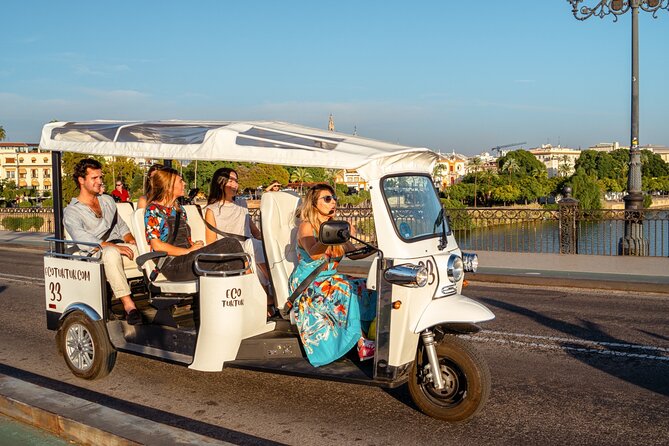
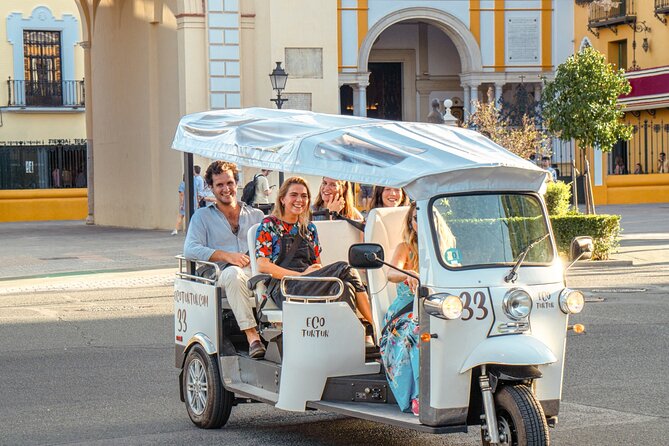
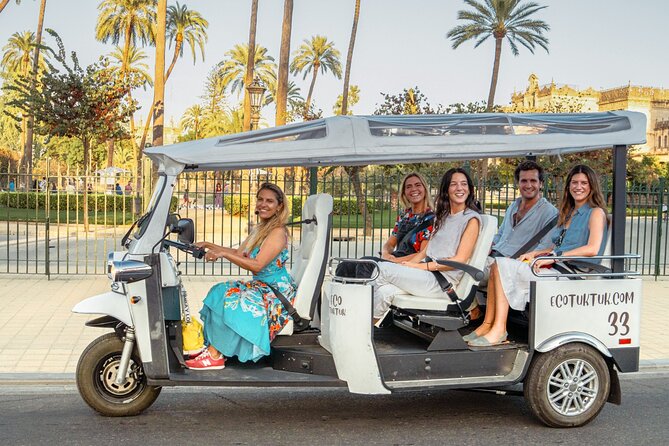
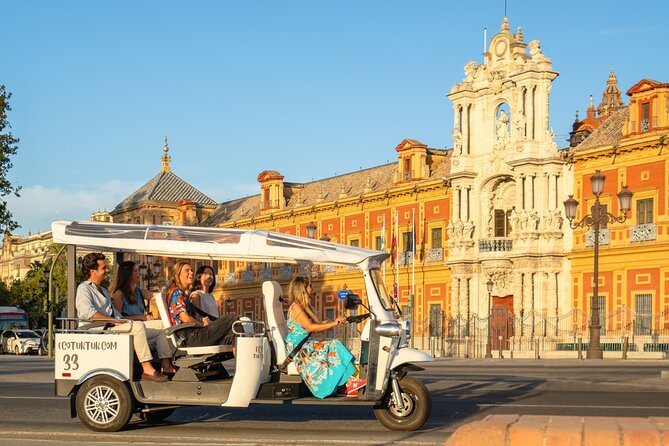
Tuk tuk makes Seville feel effortless. I love how this private eco tuk tuk format helps you cover key sights without the usual walking grind, while still getting out for quick stops and photos.
I also like the human touch. Guides such as Karen, Juan, and Miguel are repeatedly described as warm, friendly, and eager to explain what you’re seeing, which turns the ride into a guided orientation to the city.
One thing to consider: the route leans heavily on big landmarks and Expo-era spots, with short photo stops rather than deep museum time. If you crave deeper cultural context and long stops inside historic sites, you may feel it is more about highlights than depth.
Key highlights worth knowing
- Private ride, set photo stops so you can focus on seeing rather than figuring out routes
- Triana + river views for food-and-crafts energy right across the Guadalquivir
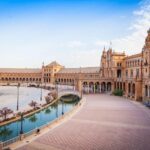
- Plaza de España and María Luisa Park for the iconic Seville postcard moment, plus real shade and space
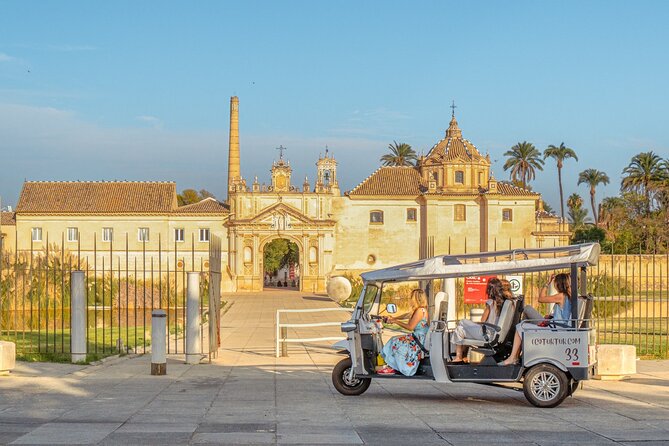
- Cartuja Monastery and Isla de la Cartuja if you like how the city reuses major buildings and exhibition spaces
- Torre del Oro and Maestranza bullring for classic river landmarks and a sense of Seville’s local traditions
- Friendly guides like Karen, Juan, and Miguel who can make a quick tour feel like a proper intro
Why a private eco tuk tuk makes sense for first-time Seville
Seville can be deceptively big. Even when you know where you want to go, the heat, hills, and uneven streets add up fast. This private eco tuk tuk tour is built for comfort, with the ride doing the heavy lifting while you still get up close to the scenery.
You’re not sharing your tuk tuk with strangers. It’s priced based on how many tuk tuks are needed for your group, with a legal maximum of 4 passengers per tuk tuk. For families and mixed-age groups, that matters, because it keeps the experience relaxed and predictable.
The tour also works well as a “starter pack” for the city. You get guided context as you move from neighborhood to neighborhood, so later, when you revisit on your own, you know what you’re looking at and why it’s there.
You can also read our reviews of more tours and experiences in Seville.
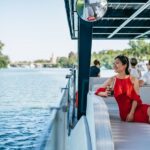
Getting started at Parking APK2 Arjona Puente del Cristo de la Expiración
Your meeting point is Parking APK2 Arjona, Puente del Cristo de la Expiración, 746, Casco Antiguo, 41001 Sevilla. The tour ends back at the same meeting spot, which is handy if you’re continuing to dinner nearby.
You’ll want to be on time. If you’re delayed, the activity can be reduced based on lost time, and if the delay is greater than 15 minutes, the activity is canceled and the amount paid is not refunded. That policy is blunt, but it keeps the whole route on track.
The good part is that the meeting area is near public transportation, which helps if you’re staying away from the center. You’ll also travel with a mobile ticket, so you can keep things simple when it’s time to check in.
Triana Bridge to Triana: food, crafts, and river rhythm
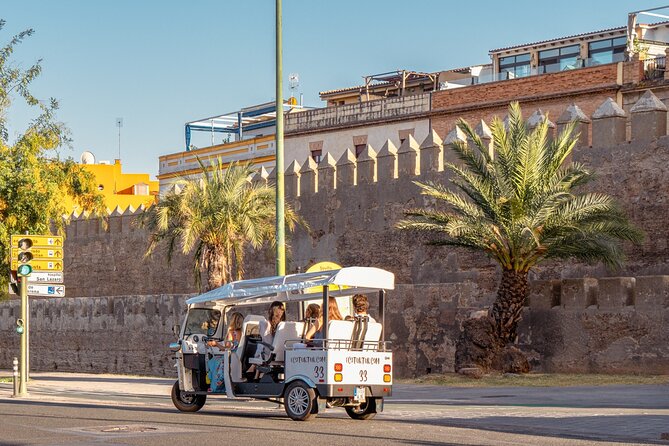
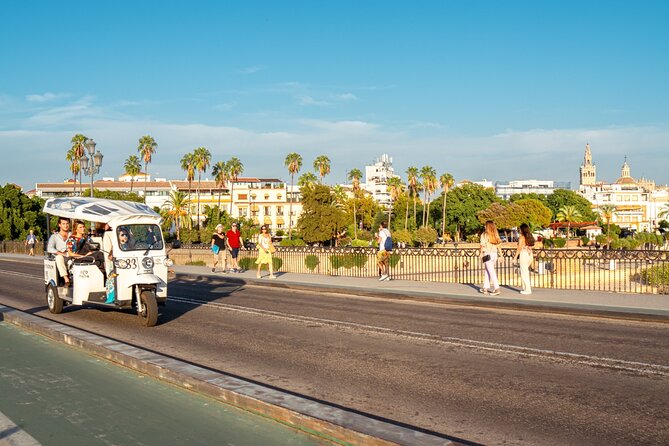
The first major stop area is the Isabel II Bridge, also known as the Triana Bridge. It links the city center with Triana across the Guadalquivir, so you get that instant “Seville has a river personality” moment.
Then the tour shifts into Triana, a neighborhood known for everyday life and market energy near the bridge. This is where I’d point you if you want to feel Seville beyond monuments, because the streets around the bridge are full of small places serving tapas like salmorejo and croquettes.
A practical tip here: your time is short, so decide what you want most from Triana on this tour. If you want ceramics and crafts vibes, head mentally toward the area around the Centro Cerámica Triana museum and nearby shops. If you want classic river views, keep your camera ready at the river-facing streets on Calle Betis.
Also, note that admission tickets for this stop are not included. The stops are mostly about orientation and photo moments, not a long sit-down visit.
San Telmo Palace and the Royal Tobacco Factory from the road
Two stops add a layer of architecture and institutional power to the tour: the Palace of San Telmo and the Royal Tobacco Factory of Seville.
San Telmo is a Baroque building that served as the seat of the Presidency of the Junta de Andalucía, and it was built between the 17th and 18th centuries as a headquarters for a sailors’ college. Even when you’re only seeing it from outside, it helps you understand how Seville’s influence was tied to sea trade and large-scale administration.
Then you reach the Royal Tobacco Factory of Seville. This is the kind of landmark that changes your mental map of the city, because it reminds you that Seville was not only art and fiestas. It was also major industry. This building was once the headquarters of Europe’s first tobacco factory established in Europe, and it’s classified as an Asset of Cultural Interest.
Neither of these stops says you’ll go in for a ticketed visit, so you should treat them as photo-and-context stops. If you want interior tours, you’d plan those separately after your tuk tuk overview.
Plaza de España and María Luisa Park: the photo stop that earns its fame
Plaza de España is the big name, and it earns its place for a very simple reason: the setting is dramatic, and it makes you want to slow down. The plaza sits inside María Luisa Park, and it was designed by Aníbal González. It was built between 1914 and 1929 for the Ibero-American Exposition of 1929.
On this tour, you get around the plaza area briefly, and the admission ticket for Plaza de España is listed as free. That means you can focus on getting photos, walking a few paths, and soaking in the geometry without worrying about an extra ticket purchase.
María Luisa Park is the “breather” between sights. It’s Seville’s first urban park and one of its green lungs. In 1983 it was declared an Asset of Cultural Interest as a historic garden, and it was inaugurated on April 18, 1914.
One consideration: you’ll be here fast. This is a quick highlight, not a long wander. If you’re visiting in peak heat, I’d still recommend this tour for the shade and open space, but after you return, plan a slower second walk so you can really enjoy the details.
Torre del Oro and Maestranza: river icons with local identity
After the park moment, the route keeps it classic with Torre del Oro and the Maestranza bullring.
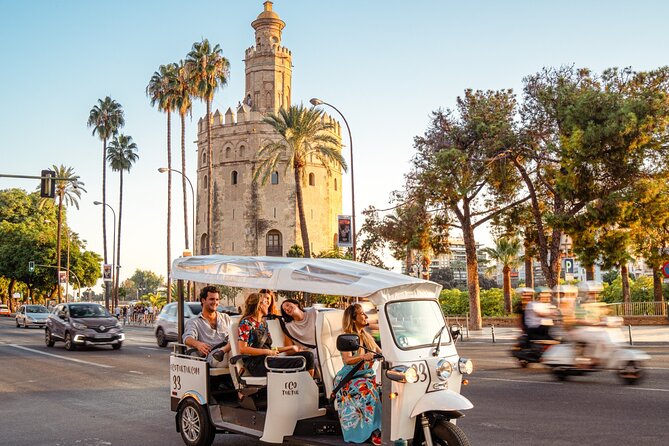
Torre del Oro is a watchtower on the left bank of the Guadalquivir, dating to 1221. It’s about 36 meters tall, and it’s made of three bodies. Even if you don’t know the dates, the tower does the job of giving your brain a reference point: this is what the river used to guard, and now it frames modern Seville’s views.
Then there’s the Maestranza bullring. It’s in the Arenal neighborhood and dates to the 18th century. The key detail for visitors is ownership: it belongs to the Real Maestranza de Caballería de Sevilla. It helps you connect Seville’s architecture to local institutions, not just travel postcards.
This part is best if you like seeing a city’s “everyday identity.” Some travelers want only cathedrals and royal palaces. I like adding one local institution that shows Seville’s cultural rhythm. Bullfighting culture is controversial, so you may just treat it as architecture and history from the outside, unless you plan a ticketed visit separately.
Cartuja Monastery and Isla de la Cartuja: where the tour shows Expo-era Seville
Now we reach one of the most interesting parts of the route, and also the one most likely to feel different depending on your expectations.
The Monasterio de la Cartuja, also called Santa María de las Cuevas, is on the island of La Cartuja. It’s a Carthusian monastery and one of four Carthusian monasteries in Andalusia. It’s a quiet-sounding stop on a tour that mostly races between highlights, so it can feel like a pause, even if you’re there only briefly.
Then the tour often continues to Isla de la Cartuja, a cultural and avant-garde space dedicated to leisure, entertainment, and art. If you like seeing how cities repurpose big spaces and buildings for modern life, this area can be a fun angle on Seville.
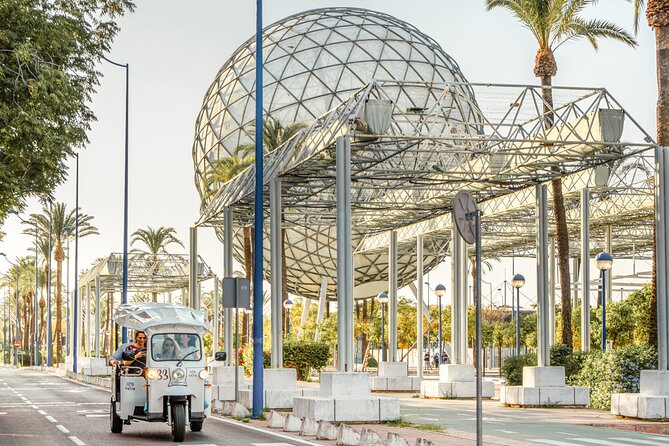
There’s also a specific icon here: the bioclimatic sphere on Marie Curie street, tied to the Universal Exposition of Seville in 1992. If you’re building a photo set, this is the kind of recognizable modern marker that makes your images feel varied, not all the same style.
Here’s the drawback to keep in mind: the route emphasizes major exhibition and repurposed sites more than long, traditional museum time. If you want heavy cultural depth, you’ll likely prefer pairing this tour with a separate, longer guided museum visit later in your trip.
Ending in San Gil: Basilica de la Macarena and neighborhood Seville
The final stop is Basilica de la Macarena, in the San Gil neighborhood within the Casco Antiguo district. It’s located at number 1 Calle Bécquer and is known formally as the Basilica of María Santísima de la Esperanza Macarena.
This ending spot is valuable because it shifts the tone from grand plaza and river landmarks to a neighborhood temple that feels integrated into daily life. Even if you don’t go inside, the location helps you understand that Seville’s big identity is not only in monuments. It lives in neighborhood devotion and street-level presence.
Admission is listed as not included for this stop, so again, you’re managing your time as an exterior and quick-visit kind of stop. If you want more, plan a longer visit during another day when you have time for a slower look.
How long is this tour, and which version should you choose?
The tour runs from about 1 to 2 hours. The short version is designed to include Plaza de España, while the longer 120-minute version also includes Isla de la Cartuja.
That difference matters for value. If you only have time for the iconic Seville postcard, the shorter option is efficient. If you want variety, you should strongly consider the longer one because it adds the monastery and the Expo-era island setting, plus that bioclimatic sphere photo opportunity.
Either way, the tour follows a fixed route with pre-established photo stops. The stops cannot be modified, and photo stops cannot be changed. That’s a good thing if you hate decision fatigue, and it’s a downside if you’re hoping to customize.
Comfort, timing, and weather: what you should plan for
The tuk tuks operate in rain or heat, and they can only be canceled under extreme conditions. In winter, the tuk tuks have protective layers against rain and wind, and they include blankets to keep you warm.
The vehicles are also suitable for seniors, and the drivers can assist you getting on if needed. That’s a real comfort detail, because the tour is about moving efficiently while still being able to enjoy what you see.
One more practical point: the itinerary may vary due to street closures or demonstrations. That’s normal in a lively city, and it can shift the order slightly, but the tour aims to keep the preplanned route and photo stops.
Price and value: what $80.23 buys you
At $80.23 per person, the question is not only cost, but what’s included that saves you time or effort.
You get an accompanying guide, private eco tuk tuk transport for your group, and a mobile ticket. Group discounts are listed too, which can matter if you’re traveling with friends or family.
You do not get general admission tickets included across the route. Plaza de España is free, but other stops are marked as not included. That means your “all-in cost” will depend on whether you plan to enter anything beyond what the tour is offering. Still, since this tour appears designed around quick stops and photos, most travelers may treat it as an orientation experience and add paid visits separately.
Compared with spending the day in taxis or trying to cover everything on foot in heat, I think the value can be strong, especially for a first or second day. It’s less about squeezing every paid attraction and more about getting a guided overview efficiently.
Who this tour fits best
This tour is ideal if you:
- Want a guided intro to Seville’s key neighborhoods and landmarks
- Prefer comfort and less walking while still getting outdoors for photos
- Are traveling with seniors, families, or anyone who benefits from easier transport
- Like seeing Expo-era Seville and repurposed spaces, not only classic monuments
It may be less ideal if you:
- Want long, ticketed time inside historic buildings during the tour itself
- Are expecting a deep dive into social history or long museum-style storytelling
- Need a fully customizable route, because stops are fixed and cannot be changed
Should you book this Seville eco tuk tuk tour?
I’d book it if you want an efficient, comfortable, and guided highlights circuit, especially if it’s your first time in Seville. The biggest win is how quickly you get oriented across river views, Triana energy, the iconic Plaza de España area, and the Cartuja island zone.
Skip it or pair it with a different kind of day if you’re chasing museum-level depth. This tour’s strength is pacing and photo stops, not hours inside buildings.
If you’re deciding between the 60-minute and 120-minute versions, choose the longer one when you can. It adds Isla de la Cartuja and the Universal Exposition-era details, which gives your trip more variety than classic plazas alone. And with guides like Karen, Juan, and Miguel repeatedly called out for their warmth and knowledge, your experience is likely to feel personal even within a set route.
More Tour Reviews in Seville
Not for you? Here's more nearby things to do in Seville we have reviewed
More Seville Tours worth a look.
 ★ 4.6Royal Alcázar Entry TicketFrom $2328,378 reviews
 ★ 4.5Cathedral and La Giralda Entry TicketFrom $2024,592 reviews
 ★ 4.7Live Flamenco Dancing Show Ticket at the TheaterFrom $2716,396 reviews
 ★ 4.21-Hour Guadalquivir River Sightseeing Eco CruiseFrom $1910,281 reviews
 ★ 4.7Cathedral, Giralda, and Royal Alcázar Guided TourFrom $699,165 reviews
 ★ 4.6Setas de Sevilla Entry TicketFrom $188,901 reviews
 ★ 4.6Cathedral, Giralda & Alcazar Entry With Guided TourFrom $658,560 reviews
 ★ 4.8Priority Access Cathedral, Giralda & Alcázar TourFrom $647,563 reviews
Continue by place or experience