
REVIEW · HISTORIC SEVILLE WALKING TOURS
Private Half Day Walking Tour of Seville
Seville clicks into place when you walk it. This private half-day route strings together major landmarks and the stories behind them, from the old city gates to the Giralda and the Real Alcázar, with a smart pace and lots of local context.
I like that you get a 30-year professional guide who tells it like a person, with humor and clear explanations. I also like how efficient the sightseeing feels, because you see the city’s key monuments largely from street level, while still getting strong connections between Seville’s Islamic past and Christian power.
One thing to consider: this is a walking tour focused on exteriors and neighborhood streets. If you want lots of inside time in specific buildings, you’ll likely need to pair this with other tickets.
Key points to know before you go
- Private group time, so the route can feel tailored to your pace
- Official guide with 30 years of experience, often with guides like Carlos and Fernando known for strong storytelling
- UNESCO stops in a compact loop, including the Cathedral area and the Real Alcázar zone
- Game of Thrones connections, including Dorne being filmed at the Alcázar
- Old city variety, from gates and shipyards to Santa Cruz patios and Seville’s famous street scenes
- Easy ending location, finishing at Plaza de San Francisco near the Cathedral area
A half-day route that strings Seville’s main highlights together
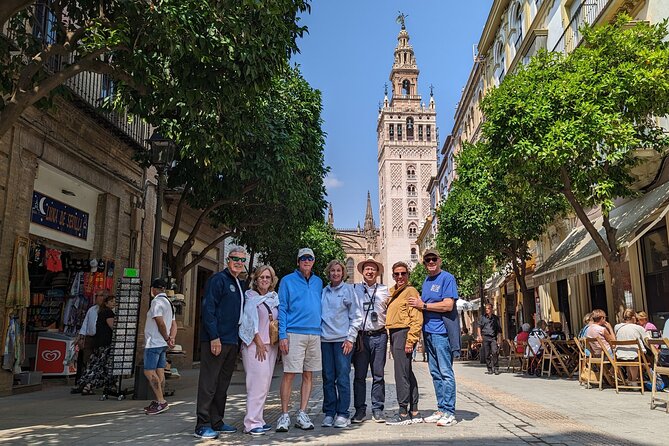
This is the kind of tour you do to get your bearings fast. In about 2 to 3 hours, you walk through the old core of Seville, picking up the who, what, and why behind the big sights. You also get context for the smaller details, like why certain buildings sit where they do and what power controlled the city at different moments.
Because it is private, the tour tends to feel less like a cattle line and more like a guided stroll. Your guide also has room to manage practical needs, and the experience is known for being attentive to things like shade in hot weather and finding what you need as you go.
The price is $133.03 per person, which is not cheap for a short walk. The value is in the guide time, the official guidance, and the amount of ground it covers without forcing you into long transport hops. Add that it includes tour photos and you get a nice set of takeaways.
You can also read our reviews of more tours and experiences in Seville.



Puerta de Jerez and the Plaza where Seville shows off
You start at Puerta de Jerez, one of the old gates of the city. Right away you get the idea of Seville as a place that keeps building over its own past, instead of wiping it clean.
Near the start you look at the Hotel Alfonso XIII, a landmark tied to the Ibero-American Exposition of 1929. Even if you never step inside, the exterior is a quick way to understand how Seville presented itself during a moment of modern ambition.
From here, the route moves through the Plaza area and into a cluster of institutions. You also see the surrounding architecture that links city life to empire-era wealth, which makes the rest of the walk feel less random.
Royal Tobacco Factory and the San Telmo story of power and trade
Next, you examine the exterior of the old Royal Tobacco Factory of Seville. The building is described as one of the biggest in Spain after the Escorial, and today it functions as the Rectorate of the University of Seville. You also get an arts connection through the note that this was the setting for the opera Carmen by George Bizet.
What I like about this stop is how it turns a massive brick presence into a story you can actually picture. Tobacco in Seville was not just a product, it was an engine of labor and administration, and the building reflects that scale.
Then you move to the Palacio de San Telmo. Historically it served as a school for navigators during the Discovery of America period, and later it became a Spanish royal residence. Its garden is now María Luisa Park, which ties the old maritime mindset to Seville’s later public-life landscape.
That transition matters. It helps you see Seville not only as postcard streets, but as a city that thought in routes, ports, and maps.
Torre del Oro and the Postigo Arch, gateways for the maritime age
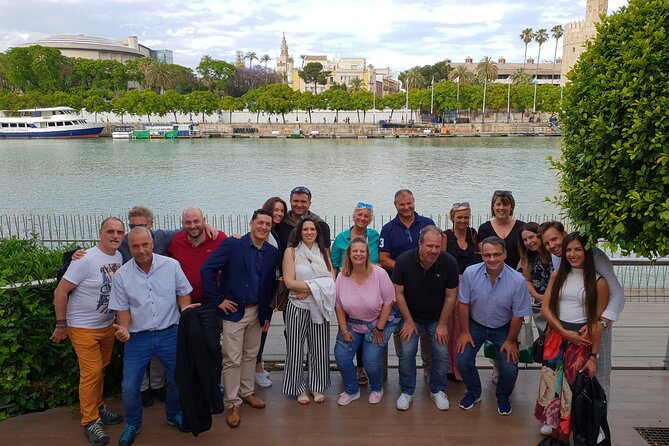
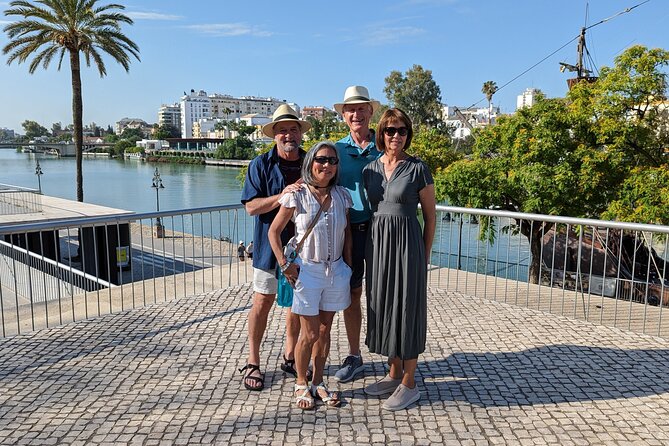
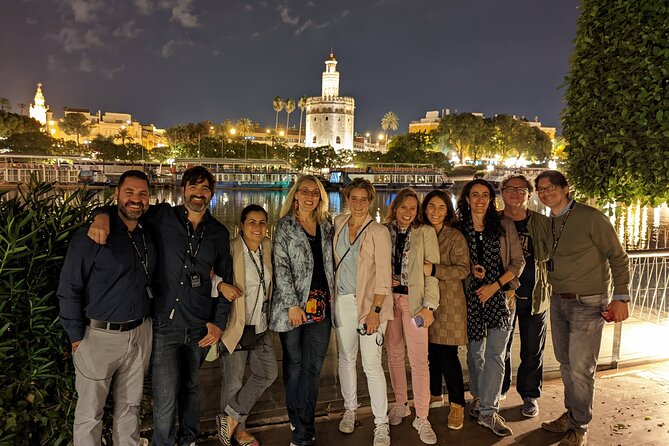
You get a strong maritime chapter with the Torre del Oro. This is an example of Islamic architecture from the 13th century, and it was important for Seville’s maritime traffic. Even from the outside, it reads as a piece of the city’s defensive and commercial system.
Then the walk shifts to gates again, including the Postigo Arch, one of the old city gates still preserved. Gates like this are useful because they show you how the city controlled movement, not just where it built monuments.
From there, you also see the Royal Shipyards exterior. The shipyards connect directly to the America story, since this is where ships headed out. You also get a modern pop-culture layer, since the area has been used for filming, including the Game of Thrones series.
This is a good moment in the tour to stand still for a minute. Look at what is functional and what is ceremonial. You start spotting patterns, which is what makes a walking tour feel worth your time.
Plaza del Cabildo and Seville Cathedral and Giralda from the outside
The route reaches Plaza del Cabildo, one of Seville’s most beautiful squares. It is tied to the Cathedral area and also connects to a practical local tradition, since an antiques market has been held on Sundays.
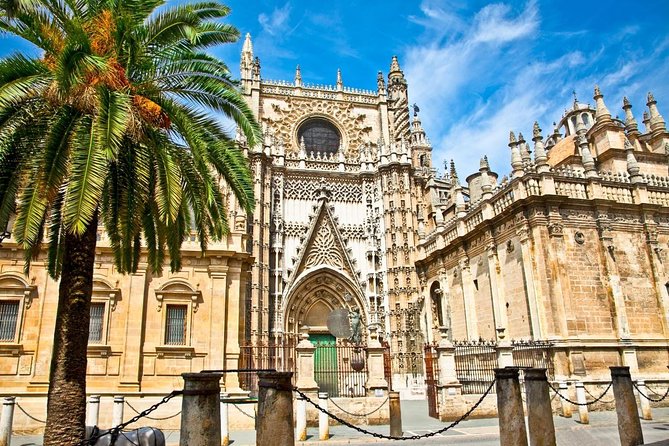
Then you approach the Cathedral of Seville from the exterior. The tour frames it as the largest Gothic temple in the world and notes UNESCO recognition from 1987. The key idea here is the blend of eras, because the Cathedral sits on the footprint of Seville’s main mosque.
That fusion is the entire point. When you understand the layers, the shape and location feel purposeful instead of random.
Next, you see the Giralda Tower from the outside. It started as 12th-century Islamic architecture and later became a bell tower when the earlier mosque was transformed into the Cathedral. The Giralda is Seville’s symbol, and seeing it in context is one of the best “aha” moments of the walk.


General Archive of the Indies, maps and Columbus papers in context
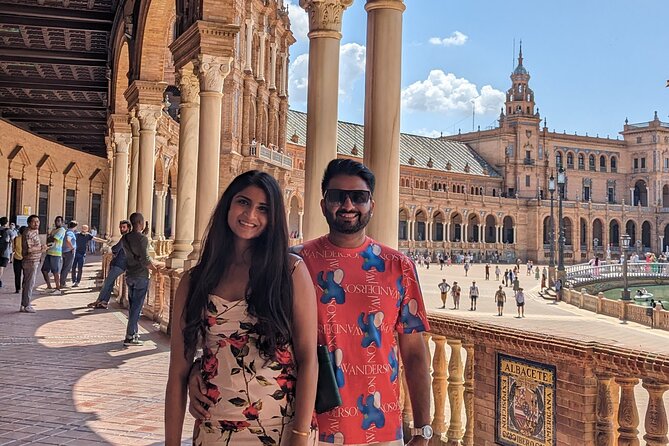
Another big step on this tour is the exterior of the General Archive of the Indies, a UNESCO-recognized building. Here the emphasis is on documents tied to America, including maps and significant records such as the Treaty of Tordesillas, plus autograph texts attributed to Christopher Columbus.
Even without going inside, you get the sense of what the building was built to do: preserve information that helped run an empire. It is history as paperwork and planning, not only battles and kings.
What makes this stop valuable is how it connects earlier maritime and shipyard stops to a later administrative layer. You stop thinking of Seville as one story, and you start seeing the whole system.
Real Alcázar exterior and Dorne from Game of Thrones
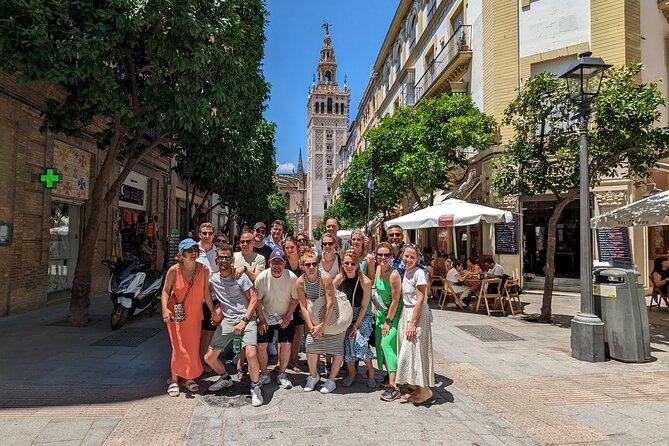
The walk then reaches the exterior zone of the Real Alcázar, another UNESCO site. It is described as the oldest royal palace in Europe still in use, and that claim alone makes the stop feel serious.
You get a guided focus on the walls and the kings who lived there. The tour also points out the Game of Thrones filming connection, including Dorne being shot at the Alcázar.
This is where many people start to smile, because the palace design reads differently once you know it was used on screen. Still, the best part is that you get the real-world palace story alongside the pop-culture reference.
If you are curious about interiors, do not assume the Alcázar is fully covered here. This is an exterior-focused walk, so treat it as a foundation. You can then decide whether you want tickets for deeper palace time later.
Santa Cruz, patios and alleys of Seville’s old Jewish Quarter
The tour moves into Barrio de Santa Cruz, Seville’s old Jewish Quarter. This neighborhood is described as Seville’s most picturesque area, with charming squares, alleys with patios, and flowers. It is also linked to opera scenes, including the Barber of Seville.
As you walk, you pass through specific squares highlighted on the route, including Doña Elvira, Los Venerables, Agua y Vida, and Plaza de Santa Cruz. Those names are more than trivia. They give you a mental map of the area, so you can come back and explore on your own after the tour ends.
If you enjoy wandering, this portion delivers. The streets and small spaces encourage you to slow down, look for details, and notice how Seville’s atmosphere changes block by block.
One practical note: this is a walking experience through older streets. Even with “moderate physical fitness” mentioned, expect some uneven surfaces and lots of time on foot.
Seville City Hall and El Salvador, Renaissance and mosque roots
You then see the exterior of the Seville City Hall, built in the 16th century during the reign of Emperor Carlos V. The tour frames it as Renaissance architecture in Seville, and it ties the building to the city’s prosperity as a gateway to America. This is another way the route keeps reinforcing Seville’s connection to global trade.
After that comes the Church of El Salvador exterior. It began as a mosque in the 9th century, later became a collegiate church in the 13th century under Fernando III el Santo, and it preserves parts of an old courtyard tied to mosque ablutions.
What I like here is the clarity of the transformation story. You see religious architecture as a cultural palimpsest, not just separate buildings dropped onto a map.
You also move through the old Islamic medina streets, which today form the commercial area. It is an easy transition from history to the Seville you actually shop and snack in.
Metropol Parasol mushrooms and Calle Sierpes, old streets meet modern icons
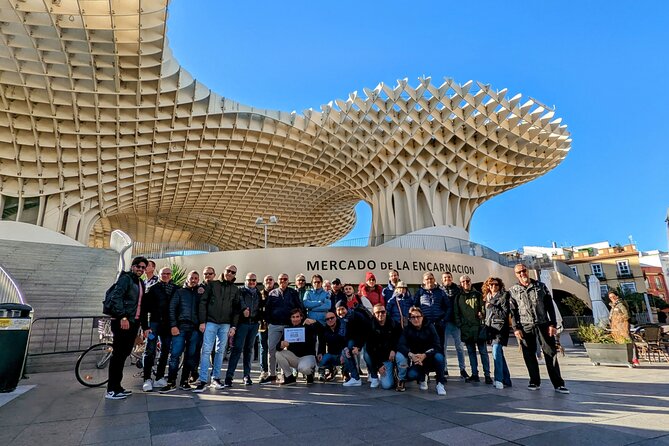
The route heads to Plaza de la Encarnación, where you can admire the Mushrooms of Seville. The tour names them as Metrosol Parasol, designed by German architect Jürgen Mayer. The idea is not subtle. This is modern architecture made to be a landmark.
Then you walk down Calle Sierpes, described as one of Seville’s best known streets, filled with shops and cafes. This is where the tour turns from monuments to everyday city life.
Along Calle Sierpes, the route also points out the old Royal Prison, connected to Miguel de Cervantes being a prisoner. This is one of those details that makes a shopping street feel deeper and more interesting.
If you want a quick photo stop and a sense of motion, this is it. You get modern street energy while still keeping the historical thread alive.
Finishing at Plaza de San Francisco, right by the Cathedral area
The tour ends at Plaza de San Francisco, near the Town Hall and close to the Cathedral area. This finish location is convenient because it leaves you close to more sights if you have extra time.
You finish where you can decide your next move easily. Go back toward the Cathedral zone for more atmosphere, or peel off into nearby streets for tapas and slow wandering.
Who this private Seville walking tour is best for
This works especially well for you if you want a guided overview of Seville without committing to a long day. It is also a solid choice if you like connections: Islamic-to-Christian transitions, Seville’s maritime role, and how the city’s big buildings relate to each other.
It is also a good match for couples and small groups who prefer a private format. If you are traveling with family, the tour feedback about guides being attentive to needs like shade and practical stops can matter.
If you are someone who wants deep interior time, you will probably want to supplement this with tickets to specific sites. This walk gives you the map and the story, not a full museum day.
Should you book this private half-day walking tour?
I think you should book it if your goal is simple and smart: get Seville’s main landmarks and the logic connecting them in a 2 to 3 hour walk. The strong ratings and repeated praise for guides like Carlos and Fernando point to what matters most on a walking tour, clear storytelling and an easygoing experience.
I would skip it or plan extra time elsewhere if you mainly want inside access and long guided entry into monuments. Since the focus is mostly exteriors and street-level views, it works best as an orientation tour, a story tour, and a launchpad for your next explorations.
If you do book, wear good walking shoes and plan for sun. Seville can be hot, and a guide who watches for shade helps a lot.
FAQ
How long is the Private Half Day Walking Tour of Seville?
The tour lasts about 2 to 3 hours.
Where does the tour start and where does it end?
It starts at Puerta de Jerez and ends at Plaza de San Francisco.
Is this tour private?
Yes. It is a private tour/activity, and only your group participates.
What language is the tour offered in?
The tour is offered in English.
What is included in the price?
It includes an official professional guide of Seville (with 30 years of experience) and tour photos.
How do I get my ticket?
You receive a mobile ticket.
Is private transportation included?
No. Private transportation is not included.
Is the tour suitable for people with mobility needs?
The tour requests moderate physical fitness.
Are service animals allowed?
Yes. Service animals are allowed.
What weather is required?
The experience requires good weather. If it is canceled due to poor weather, you’ll be offered a different date or a full refund.
More Tour Reviews in Seville
Not for you? Here's more nearby things to do in Seville we have reviewed


More Historic Seville Walking Tours worth a look.
 ★ 5.0Small-Group City Highlights Walking TourFrom $271,204 reviews
 ★ 5.0Cultural Walking Tour of Seville MonumentalFrom $8861 reviews
 ★ 4.9Tapas, Taverns, and History Walking TourFrom $84676 reviews
 ★ 4.9Tapas, Taverns and History Guided Walking TourFrom $99515 reviews
 ★ 4.9Small-Group Jewish Quarter Discovery Walking TourFrom $29499 reviews
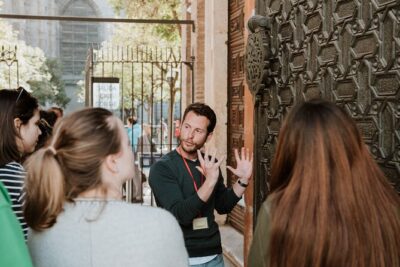 ★ 5.0Seville Guided Small-Group Walking TourFrom $21435 reviews
 ★ 5.0Seville Private Walking Tour with Alcazar & Cathedral TicketsFrom $276332 reviews
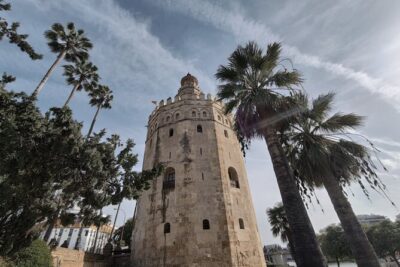 ★ 5.0Seville Small-Group Monumental Highlights Walking TourFrom $30278 reviews
Continue by place or experience