
REVIEW · SEVILLE BIKE & E-BIKE RIDES
Seville Bilingual Bike Tour
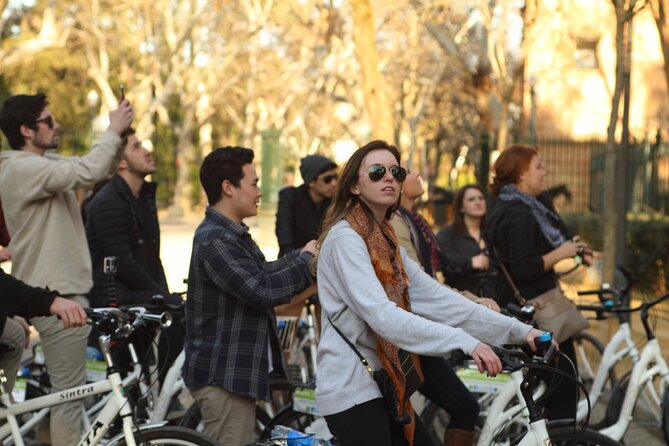
Seville by bike changes the whole rhythm of your visit, and this 3-hour bilingual tour makes it easy. I especially like the tight mix of big-ticket monuments plus local streets, starting around Plaza del Salvador and rolling through places like Plaza de España and Maria Luisa Park. You’ll also get guided context as you pedal, so the sights feel connected instead of like a checklist.
Two standout wins for me are the Cathedral and Giralda stop, and the final contrast at the Plaza de la Encarnación Mushrooms, where old Seville meets something more modern. A real consideration, though, is that this is an outdoor cycling tour, and it runs only when weather is good, so you’ll want a plan for rerouting if conditions turn.
Key Highlights Worth Your Time
- A bilingual guide who helps you connect the dots between Seville’s landmarks
- Major monuments in one loop, without spending the whole day walking
- Plaza de España and Maria Luisa Park seen from an easy cruising pace
- Cathedral and the Giralda stop, including time near the roofline view area
- Torre del Oro and Real Maestranza for architecture and landmark variety
- Small group cap of 20, so questions do not get swallowed by the crowd
Why Seville Looks Different From the Saddle
Seville is the kind of city where you can walk and walk and still feel like you are only seeing a slice. On a bike, you get the wider context fast: streets, plazas, and the way neighborhoods flow into each other. In only about 3 hours, you get to experience several of the city’s most recognizable sights, plus the in-between charm.
I like that the tour is built around moving efficiently. You are not just stopping at one famous place and hoping you can wing the rest. Instead, the route threads through a real cross-section of Seville, from civic squares to religious landmarks, and then out toward parkland and riverfront scenery.
One more thing: biking keeps the experience active. If you tend to get museum-tired or step-count tired, this is a good antidote. You stay engaged because your guide is moving you, and you are always either steering, braking, or looking around.
You can also read our reviews of more tours and experiences in Seville.

Getting Started Near the Center: Meeting at Centerbici
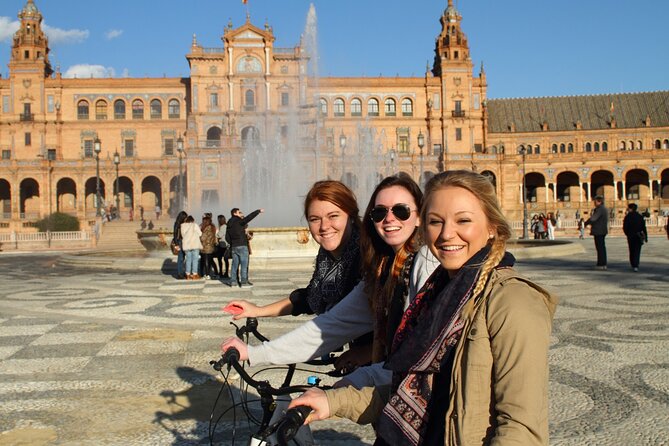
You’ll meet at Centerbici at C. Espronceda, 5, in the Casco Antiguo area, and you end back at the same spot. The meeting point being near public transportation matters because it makes life easier if your plans include trains, buses, or a last-minute switch to a different time window.
The essentials are handled for you: you get the bike, plus a map and a water bottle. Kids also get a helmet, and children must be accompanied by an adult, so it stays family-friendly in a clear, straightforward way.
Price-wise, the tour sits at $36.11 per person for roughly 3 hours, and it includes the big cost items you would otherwise figure out yourself, like bike rental and a guide. One tradeoff is that transportation to and from attractions is not included, so you’ll still want to handle getting yourself to the start point.
Plaza del Salvador, San Francisco, and Plaza Nueva City Hall
The tour kicks off from Plaza del Salvador and heads toward Plaza de San Francisco and then Plaza Nueva. These are classic Seville staging points, where the architecture and the street layout help you understand what the city chose to highlight in public life.
I love the stop at Plaza Nueva because it brings you face-to-face with the city hall in plateresque style. Plateresque is the kind of ornate detailing that can be hard to appreciate when you are rushing. On a bike, you get close quickly, but you are also not stuck in the long queues and slow crowd bottlenecks that sometimes happen when everyone tries to see the same façade on foot.
This stretch also helps you get your bearings. You’ll feel the geography of the historic center right away, and it becomes easier to picture how everything connects as you continue.
Plaza de la Constitución, the Cathedral, and the Giralda Roofline
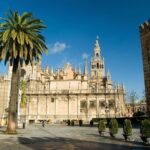
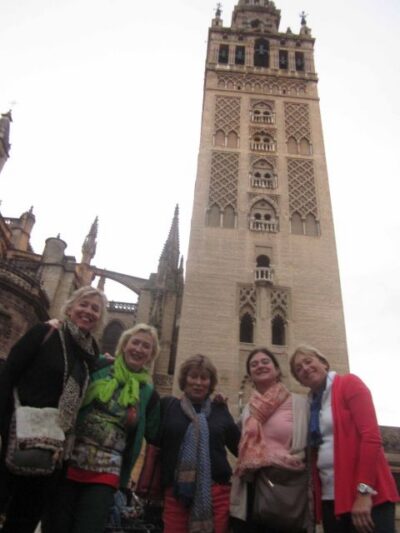
From civic squares, the route turns toward Plaza de la Constitución, where the energy shifts from public life to religious power and artistic ambition. This is where you get a visit focused on Seville Cathedral and the Giralda roofline, which is a huge part of the city’s skyline identity.
I like this sequence because it mirrors how many visitors naturally experience Seville: you come for the landmarks, but you appreciate them more when you understand how they sit within the broader city fabric. The guide’s role matters here. Instead of you standing there trying to decode stonework details by guesswork, you get the story while you’re still oriented and not mentally exhausted.
One practical consideration: this portion can involve slow looking time. The tour keeps you moving overall, but it is not a speed run. If you like photos, you’ll have moments to take them without feeling like you are sprinting from one stop to the next.
Old Tobacco Factory and Prado de San Sebastián: A Change in Mood
Next, the tour moves toward the old tobacco factory area and continues along Prado de San Sebastián. This part of the route is valuable because it adds variety. After the cathedral-scale landmarks, you get a different kind of Seville feel, where buildings and streets help show how the city functioned beyond the obvious tourist icons.
I find this kind of stop useful even if you think you already know Seville. It helps you see the layers, the way industrial or institutional spaces shaped the city, not just the religious and royal ones.
Also, you don’t have to cram everything into your head. Cycling means you absorb the rhythm of the neighborhood while still covering ground. You get a calmer mental reset before you reach the big open spaces.
Plaza de España and Maria Luisa Park: Space, Symmetry, and Easy Views
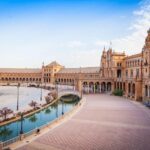
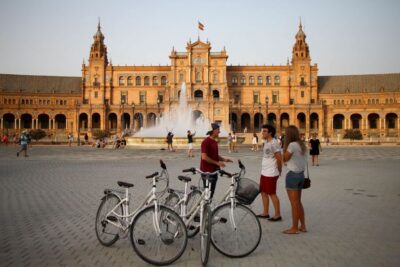
Then comes one of the most satisfying parts of any Seville route: Plaza de España and Maria Luisa Park. This is where the city opens up. The plaza gives you architectural scale and strong visual lines, and Maria Luisa Park gives you breathing room and a softer pace.
You’ll appreciate this section if you like your sightseeing to include both drama and ease. On two wheels, you can reach the main sights without turning your day into a long-distance walking test. You also get unique perspective, because even when you stop for photos, you are not standing still in the same crowd flow as everyone else.
The tour includes the New York Dock area as part of this zone, so you are not just circling the same famous corners. And the route is designed so you do not feel trapped in one spot. You can look around, listen, and still keep rolling.
Drawback? This is the section where the light and crowds can be most noticeable. The bike format still helps, but if you are extremely photo-precise, plan to be patient and take your shots in the gaps when the group is repositioning.
Real Maestranza Bullring and Torre del Oro by the Water
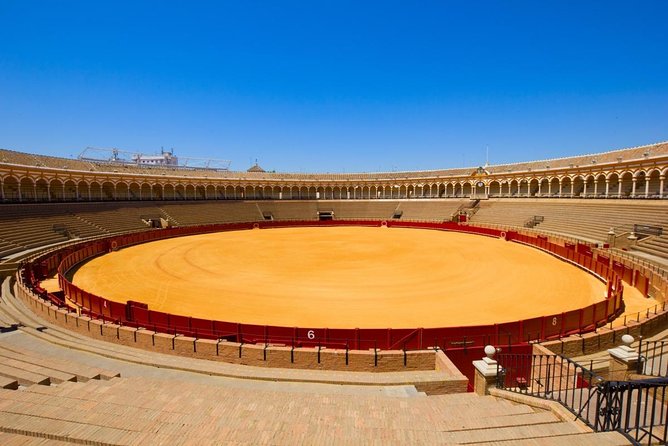
After the park zone, you head toward Real Maestranza, the bullring area, and then on toward Torre del Oro. This is a smart shift because it takes you from open plaza space to a landmark rhythm that feels more historical and river-linked.
I like that Torre del Oro is included because it’s a recognizable symbol, and it pairs well with the bullring stop for variety. You are not just repeating the same architectural type over and over. Instead, you get civic and religious power, then open-space beauty, and then landmarks tied to Seville’s identity and river presence.
From a value standpoint, this is where the bike tour earns its keep. You cover enough distance that you would likely lose half the day trying to connect these points by foot. And since the tour has a maximum of 20 travelers, it stays manageable. You are not dodging a sea of people at every stop.
Plaza de la Encarnación Mushrooms: History and Modern Contrast
The tour ends with the Mushrooms of the Plaza de la Encarnación, a famous late addition that creates a striking contrast with everything you saw earlier. This final stop is more than a photo moment. It’s a way to close the loop: you start in the historic center, move through monumental layers, and then finish with something that feels like Seville looking forward.
I especially like the timing of putting this near the end. By then, your brain has already sorted the major landmarks into mental categories. So when you reach the Mushrooms, you notice the contrast more clearly. It feels like a palate cleanser, not just another stop.
If you like modern design that uses history as a backdrop, this section is the one you will remember most clearly. Even if you are not a design nerd, the physical structure is hard to ignore.
Bilingual Guide Quality: What Makes the Experience Feel Easy
A big reason this tour scores highly is the guide experience. The tour is described as bilingual, and the guidance style seems to land well with different language needs. In the feedback you were given, names like Fadi and Daniele come up, both praised for being friendly and well prepared, and for switching languages smoothly.
That matters more than you might think. When a guide is genuinely comfortable in both languages, the explanations stay clear for everyone. You don’t lose half the meaning because you are stuck reading captions or translating in your head.
It also keeps the tour fun. The more “informed and fun” the guide is, the less the stops feel like checkboxes. You get stories tied to what you are actually seeing right now, which helps the architecture sink in.
Price and Value: Is $36.11 a Smart Deal?
At $36.11 per person for about 3 hours, the price is one of the strongest reasons to consider booking. The tour includes the bike, bilingual guide, water bottle, and a map. It also includes a helmet for kids, and that is a practical cost you often end up paying separately on other tours.
What’s not included is also clear: transportation to and from attractions. In most cases, that means you plan only for getting yourself to the meeting point and back. Once you are on the bike, the tour handles the movement between sights.
For value, think about what you would do solo. You would probably need to rent a bike, then pay for guide time or accept less context. This gives you a guided framework for less than the cost of bike rental plus a private guide in most cities.
The only caution on value is weather. Since the experience requires good weather, you want to book with flexibility. If your dates are rigid and you travel during a rainy stretch, you might be safer choosing a different plan that does not depend as much on outdoor conditions.
Who This Tour Fits Best (and Who Should Rethink It)
This tour works well if you want a big overview of Seville’s top sights without turning it into a full-day slog. You get monumental stops like the Cathedral and Giralda area, plus open-space highlights like Plaza de España and Maria Luisa Park, plus river-linked scenery near Torre del Oro.
It is also a good option if you like your information delivered while you are moving. Instead of wandering with a guidebook and guessing what matters most, you follow a route that naturally builds from one theme to the next.
You might rethink the tour if you have limited comfort with cycling for a couple of hours. The activity is designed for most travelers to participate, but you are still committing to time on a bike. If you know you prefer seated, slow sightseeing, you may enjoy a walking or transit-based option more.
For families, the tour is explicitly set up for children, with kids getting a helmet and needing an adult. That’s a clean, helpful setup.
Should You Book This Seville Bilingual Bike Tour?
I’d book this if your goal is simple: see a lot of Seville’s most famous landmarks in a short window, with a bilingual guide that helps you understand what you are looking at. The route is built around both power sights and mood shifts, from Plaza de la Constitución to Plaza de España, and then to the Plaza de la Encarnación Mushrooms.
Book it especially if you want to keep energy high. Three hours is long enough to feel like you did something meaningful, and short enough that you still have time to wander on your own afterward. And because the group is capped at 20 travelers, you should get a more personal guide experience than on mega-tours.
Before you go, just watch the weather closely. This one depends on good conditions, and an outdoor cycling tour is not the kind you want to force in poor visibility or heavy rain.
If your travel style is photo-friendly, history-informed, and practical, this is the kind of tour that makes Seville click fast.
More Tour Reviews in Seville
Not for you? Here's more nearby things to do in Seville we have reviewed
More Seville Bike & E-Bike Rides worth a look.
 ★ 5.0Seville Highlights Bike Tour (English)From $422,225 reviews
 ★ 4.8Highlights City Bike TourFrom $382,168 reviews
 ★ 4.8Relaxing City Bike Tour with a Tour GuideFrom $351,588 reviews
 ★ 4.9City Sightseeing and Local Culture Bike TourFrom $311,120 reviews
 ★ 5.0Seville Electric Bike Tour – Small GroupFrom $58841 reviews
 ★ 5.0Sunset Guided Bike Tour in SevilleFrom $36438 reviews
 ★ 4.9Guided Sunset Bike TourFrom $41332 reviews
 ★ 5.03-hour Guided Bike Tour along the Highlights of SevilleFrom $39315 reviews
Continue by place or experience