
Medieval Seville is only a short walk away. I love how this 75-minute route pushes you through the oldest-feeling streets fast, then lands you near the heavy hitters: the Santa Cruz Quarter, the Gothic Cathedral, and the Real Alcazar. One thing to watch, though, is that entrance tickets are not included, so you may still need to plan for monument entry time and separate costs.
This tour is built like a compact time machine. You start near the Cathedral area, then follow a story of Seville through Roman and Arabic names, the city’s New World wealth, and the big international shows that put Seville on the world map. It’s guided in Spanish, and on some days it can run in two languages, which helps if you want more clarity while you walk.
Because it stays on foot, your comfort matters. Bring water, wear good shoes, and be on time at the meeting point near the Cathedral. If you need to lock in exact monument entry, keep a little flexibility in your day.
Key Things to Know Before You Go
- Santa Cruz, old and new Jewish quarters: You’ll walk the Barrio Santa Cruz area and hear how the Jewish story fits into Seville’s present.
- Major monuments on one loop: The route ties together the Cathedral and the Real Alcazar area so the medieval feel has a payoff.
- Legends that connect the dots: You get the Hercules, Roman Hispalis, and Arabic Isbiliya timeline that makes the streets feel less random.
- Calle del Beso and romantic squares: The tour uses famous lanes and small plazas to point out atmosphere, not just landmarks.
- Short, guided, and practical: At 75 minutes, it’s a fast way to get oriented before you decide what to linger on later.
- Guide quality can make the difference: A guide named Sara has been praised for being especially engaging and leaving room for questions.
Starting at Plaza del Triunfo, then moving through the Cathedral and Alcazar zone
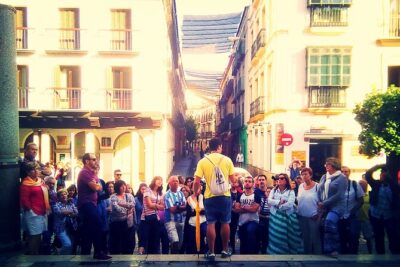
Your tour meets at the foot of the Monument to the Immaculate, right by the Cathedral at Plaza del Triunfo. That’s a smart starting choice because it puts you beside the biggest visual anchor in the center. From there, you’ll be walking through the streets that connect the Cathedral area with the Real Alcazar zone.
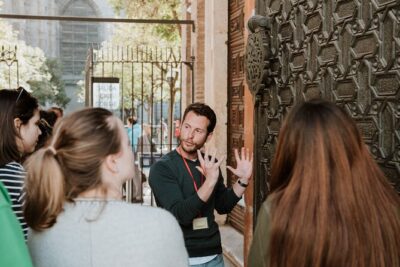
The walk is designed to help you see patterns. Instead of treating each street as a random postcard, the guide frames what you’re looking at. That matters because Seville can feel like one long maze of lanes, and without a guide’s thread, it’s easy to get lost in the vibe but miss the meaning.
Expect a steady pace for just 75 minutes. This is not a long sit-down history lesson. It’s more like guided street-reading: where to look, what to notice, and why a certain corner or arch matters. If you like learning quickly and then spending the rest of your day exploring at your own rhythm, this format works well.
You can also read our reviews of more tours and experiences in Seville.



Plaza Nueva to Plaza del Triunfo streets: Seville’s name changes and big-time history
Seville’s story starts far back, and the tour uses that timeline to make sense of the city’s layers. You’ll hear the legend that Sevilla was founded by Hercules, then named Hispalis under Roman rule. Under Arabic rule, the name shifts again to Isbiliya. Even if you treat some of the earlier parts as legend, the point is clear: Seville got built up by successive cultures, and the old city kept reinventing itself.
The guide also ties that long timeline to Seville’s modern global role. You’ll hear how the city rode the wealth of the New World after the discovery of America. Then come the big international events: the Ibero-American Exposition of 1929 and the Universal Exhibition of 1992. That contrast helps you understand why the city feels both intensely historic and surprisingly international.
For you, the payoff is orientation. After hearing the names and eras, the streets start to feel like a sequence instead of a blur. You’ll likely find yourself looking at the Cathedral and the Alcazar with clearer expectations, because you now know what kind of eras shaped the city you’re standing in.
Real Alcazar and the Gothic Cathedral area: what you’re really paying attention to
The tour specifically focuses on the area around the Real Alcazar and the Gothic Cathedral. These two sites are not just famous. They’re also great “visual anchors” for understanding Seville’s style shifts over time.
The Cathedral of Seville is one of the largest cathedrals in the world, and the guide uses its presence to steer your attention as you walk. You’re not going to get a full architecture masterclass in 75 minutes, but you will get enough to recognize what makes it different from other Spanish churches. Even outside, you’ll be primed to notice features and scale, so your future visit feels more informed.
Then there’s the Real Alcazar of the Moors, described as imposing. The tour brings you to the streets surrounding the complex, so you can take in the “major monument” energy without being stuck waiting for entrances right away. That’s a practical advantage. You get the feel and context first, then you can decide whether you want to return for a timed entry.
Important practical point: entrance tickets are not included. The tour does include help with skipping the ticket line, but you should still expect separate monument entry costs and entry steps. If you’re trying to do everything in one day, build in time buffers for the monuments.
Entering Barrio Santa Cruz: narrow streets, Jewish quarters, and the legend layer
The star neighborhood is Barrio Santa Cruz, the famous area often tied to Seville’s Jewish history. On this tour, you don’t just get a single slice. You’ll enter both the old and what’s described as the new Jewish neighborhood.
That matters because “Santa Cruz” can get treated like one fixed image, all winding lanes and romance. The guide adds structure to that. You’re walking through a place where different eras and identities have left marks, and the tour helps you place the Jewish story into the broader medieval picture of Seville.
Expect the street feel to be part of the lesson. You’ll stroll narrow lanes that can look similar at first glance. But with the guide’s framing, you’ll start to understand what the area represents and why certain streets get singled out.
This is where the guide quality shows up most. When a guide is strong, the neighborhood feels like a living map. When the guide is less confident, the same lanes still look beautiful, but you may feel like you’re mostly watching the scenery instead of learning how the scenery connects.
Calle del Beso and romantic squares: atmosphere that actually makes sense
One of the named highlights is a stroll down Calle del Beso, also known as Street of the Kiss. It’s the kind of lane that works perfectly for a short guided route because it gives you a specific place to attach the story to. Instead of hearing facts in the abstract, you’re hearing them while standing where the legend is tied to the street.
After that, the tour points you toward romantic squares. These are small, open pockets in the maze of streets. They’re ideal stops because you can look around and realize how Seville’s medieval feel is created through spacing: tight streets, then a sudden release into a plaza where you can catch your breath.
If you’re the type who likes photos but also likes why a place looks the way it does, you’ll probably enjoy this part. It’s not only about finding pretty corners. It’s about noticing how Seville sets up drama at street level, then slows you down in the squares.
It’s also a reminder of what the tour is best at. It’s a guided sampler. You get the mood cues, and then you can choose what to revisit later without feeling overwhelmed.





Tour pace, language, and how to get the most from 75 minutes
At 75 minutes, you should think of this as a first-pass tour. It’s long enough to connect Seville’s medieval story to the major monument zone, and short enough that you won’t lose your whole day to one activity.
You’ll want to bring a simple strategy: decide what you want to learn first, then what you want to do after. If you’re coming to Seville for the Cathedral and the Alcazar, you’re already in the right headspace. If you’re more interested in neighborhoods and legends, the Santa Cruz focus will keep you engaged.
Language is Spanish, and on some occasions the tour could be conducted in two languages. That can be helpful if you want extra clarity. I’d also say this for your decision-making: if Spanish is not your strong suit, still go with realistic expectations. One guide named Sara has been praised for being engaging and knowledgeable, and another has been described as having good English. On other days, language delivery may be more tentative, so choose based on what you can handle.
Another practical note: the operator is not responsible for delays at the entrance to monuments. So if you’re very timing-sensitive, don’t assume every site will match a perfectly neat schedule.
Price and value: what $47 covers, and what you still pay separately
The price is $47 per person. For that, you get a guide plus fees and related taxes. You also get ticket-line help. What you do not get is entrance tickets.
So the value calculation is simple:
- If you primarily want orientation and stories while you walk, the price is strong. It’s focused, time-efficient, and aimed at connecting the medieval themes to the places you’ll likely want to revisit.
- If you’re hoping the tour price covers monument entry too, you’ll need to budget extra. Entrance tickets are not included, so your final cost depends on what you plan to enter beyond the walk.
I also like that the structure includes “included” guidance but doesn’t lock you into long indoor ticket time. That gives you freedom after the tour to pick what matters most to you.
Practical tips so your medieval walk goes smoothly
Seville works best when you respect the old-city foot traffic. Here’s how to make the most of this tour with what you know upfront:
- Wear comfortable shoes. The streets around Santa Cruz and the Cathedral area are not designed for casual flip-flops.
- Bring a bottle of water. The tour is not long, but walking in Andalusian conditions can still catch you.
- Arrive on time at the meeting point by Plaza del Triunfo. Being late can throw off a tour that has a tight 75-minute window.
- Have a flexible mindset about timing. The operator does not control delays at monument entrances.
- If your group is small, note the minimum of 2 adults per booking. If you’re traveling solo as an adult, you may need to join another booking or plan another format.
- If you’re traveling with kids, they must be accompanied by at least 2 adults.
One more “real life” consideration: a past cancellation happened about an hour before the start time. If your day is tightly scheduled, keep an alternate plan in mind so you are not stuck.
Should you book this Seville Medieval Walking Tour?
I’d book it if you want a fast, guided introduction to medieval Seville that connects Santa Cruz with the Cathedral and Real Alcazar area in one go. It’s especially good for first-timers who want the story thread, not just the landmarks. The guided street-reading style works well in a city where the lanes look similar until someone gives them meaning.
Skip it, or at least think twice, if you need entrance tickets included in your price, or if you have zero flexibility for monument entry timing. Also, if you are sensitive to the possibility of last-minute changes, consider booking in a way that keeps your day workable.
If you’re the type of traveler who loves narrow streets, legends, and the feeling of history without committing to a long day indoors, this is a solid, practical choice.
More Tour Reviews in Seville
Not for you? Here's more nearby things to do in Seville we have reviewed










More Historic Seville Walking Tours worth a look.
 ★ 5.0Small-Group City Highlights Walking TourFrom $271,204 reviews
 ★ 5.0Cultural Walking Tour of Seville MonumentalFrom $8861 reviews
 ★ 4.9Tapas, Taverns, and History Walking TourFrom $84676 reviews
 ★ 4.9Tapas, Taverns and History Guided Walking TourFrom $99515 reviews
 ★ 4.9Small-Group Jewish Quarter Discovery Walking TourFrom $29499 reviews
 ★ 5.0Seville Guided Small-Group Walking TourFrom $21435 reviews
 ★ 5.0Seville Private Walking Tour with Alcazar & Cathedral TicketsFrom $276332 reviews
 ★ 5.0Seville Small-Group Monumental Highlights Walking TourFrom $30278 reviews
Continue by place or experience