
REVIEW · TRIANA QUARTER EXPERIENCES
Seville Triana Quarter and River Small-Group Walking Tour
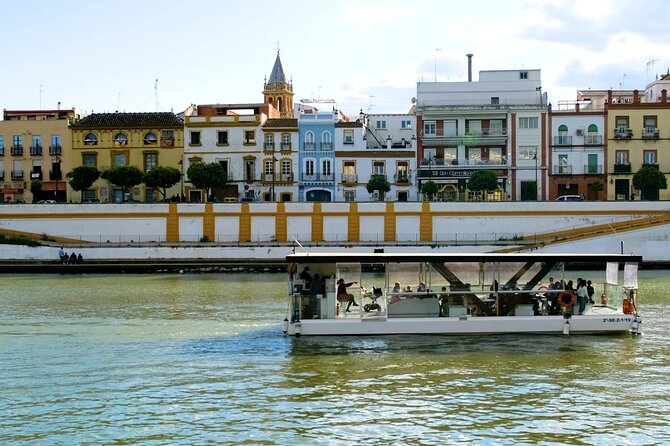
Triana feels like it has a pulse. This small-group Seville walk pairs the Guadalquivir River with the neighborhood across the water, mixing street-level sights with big moments like the Inquisition’s local power and Triana’s famous Holy Week traditions. I love how the group stays to a maximum of 10, so your guide can actually answer questions while you’re on the move. I also like that you’re walking the whole time, which makes it easier to understand how the river shaped everyday life. One possible drawback: with only about 1.5 hours, you’ll get strong highlights, but you won’t have time for long, quiet museum-style detours inside every stop.
The route is designed for real orientation. You’ll start at the river, cross the historical connection points, and end at a major Triana church, so your feet do the thinking for you. The walk is also practical for a lot of visitors because the area is generally easy to navigate on foot, and you’ll have both morning and afternoon start options to fit your day. If you hate standing around to listen, just know the tour is intentionally story-driven, with multiple brief stops to explain what you’re seeing.
Key Things That Make This Tour Worth Your Time
- Small-group cap of 10 keeps the pace human and the questions personal
- River-to-Triana route helps you understand Seville’s geography fast
- Castle of San Jorge and Holy Week sites add depth beyond typical sightseeing
- Market and ceramic craft stops show how local culture becomes Mediterranean flavor and art
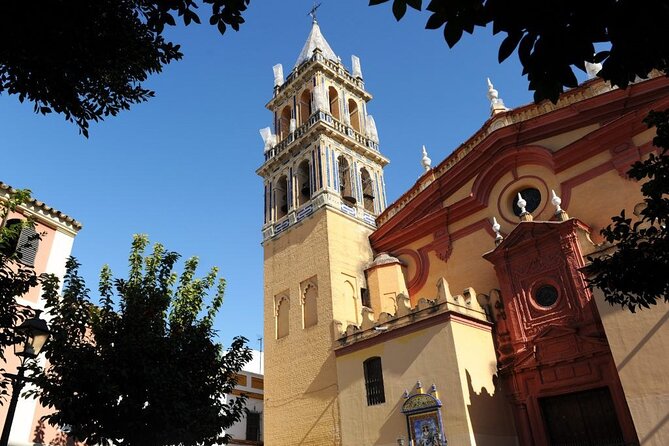
- Mudéjar architecture at Real Parroquia de Señora Santa Ana ties style to Seville’s past
- Two daily start options make it easier to slot into a tight itinerary
Starting at Torre del Oro, Then Letting the River Guide You
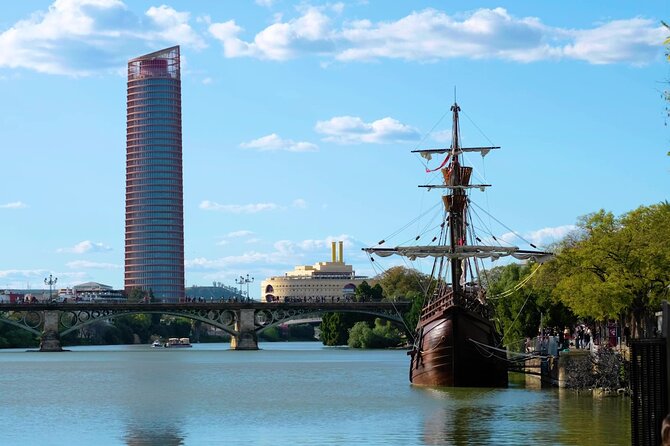
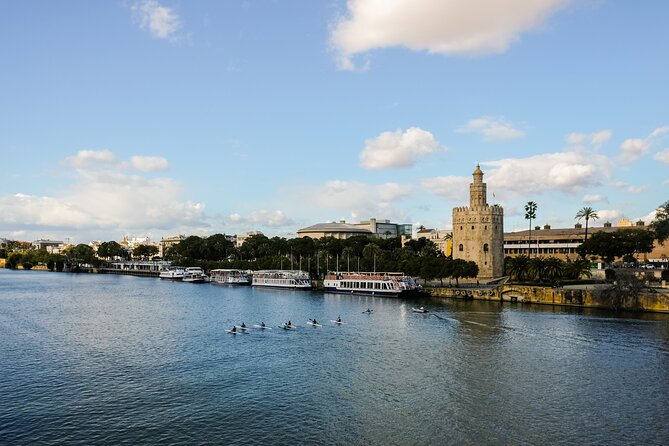
Your tour begins at the Torre del Oro (Golden Tower) on the river promenade. Even before you hit the first major story, you get something valuable: a sense of direction. Standing by the river helps you connect all the later stops, because the Guadalquivir isn’t just scenery, it’s the reason Seville grew the way it did, and why Triana matters.
From there, your guide frames what comes next in plain terms. You’re not just looking at buildings, you’re learning how they defended, traded, and shaped neighborhoods. This is where a good small-group format earns its keep, because your guide can point out details right where your eyes naturally land, instead of expecting you to guess later.
Practical tip: wear comfortable shoes. You’re on foot for the whole experience, and even with short stops, it adds up.
You can also read our reviews of more tours and experiences in Seville.



A Watchtower Built for Ships, and the Idea of Many Cultures
One of the first stops is at a watchtower built over 800 years ago to defend Seville’s access for ships. This isn’t abstract history. It explains the logic of the city’s defense strategy, and why the riverfront needed protection, not just beauty.
Next, you’ll see a more modern monument that represents the different cultures that have called Seville home and managed to coexist there for centuries. It’s a clever contrast. You look at the old defensive mindset first, then you watch the city shift toward a long record of cultural layers, instead of a single straight-line story.
I like this sequence because it helps you read Seville like a living document. You start with function, defense, and movement. Then you move to identity and coexistence, which makes Triana’s later religious and craft stories feel connected instead of random.
The Iron Bridge Story: How Triana Was Linked
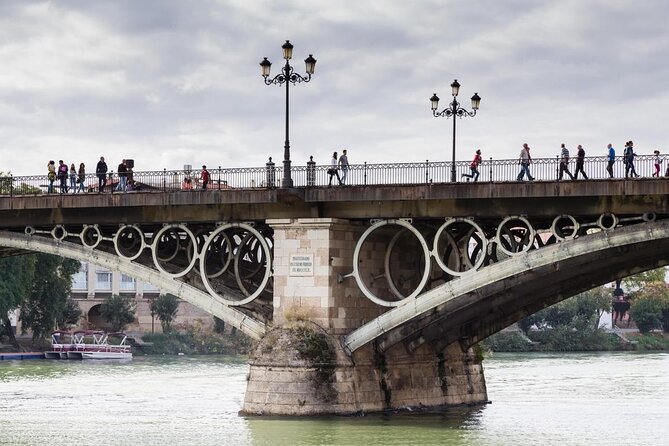
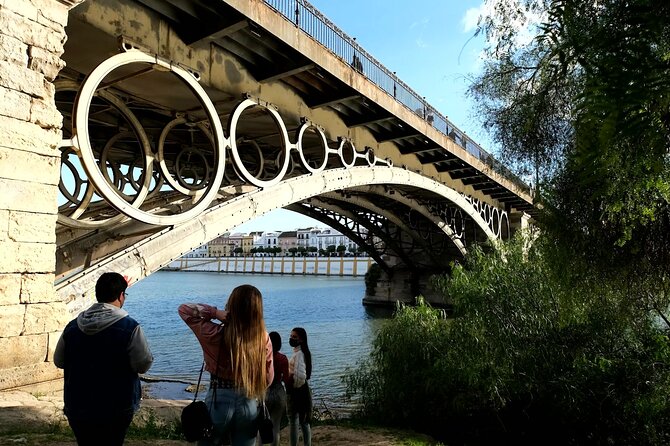
Triana sits just across the river, so the connection between the neighborhoods is a big deal. At one point, you’ll walk past the first fixed bridge of Seville, built to replace a former floating bridge that connected the city with Triana. The explanation focuses on why that shift mattered, plus what it tells you about engineering in the 1800s, including the famous iron architecture approach.
Why should you care about a bridge on a walking tour? Because bridges change daily life. When you replace a fragile or temporary connection with something fixed, you make movement more reliable. That impacts trade, religion, and even how neighborhoods feel about each other.
Also, bridges give you a breather for photos and regrouping. If you want a quick snapshot of the river angle, this is a good spot to pause.
Triana’s Market and the Food Logic of Mediterranean Cuisine
At the traditional neighborhood market stop, the focus turns to products and everyday life. You’ll learn why these local goods mattered, and how they fed into Mediterranean cuisine. This is the kind of food story that’s useful even if you never eat a single snack on tour. It gives you a lens for what you’ll notice later in shops, stalls, and restaurant menus.
Market time on a walking tour is short by nature, so don’t expect a full tour of recipes. Instead, use it to train your instincts. When you later see items tied to local production, you’ll understand why they’re there and why they show up together.
If you like travel that helps you order smarter meals, this market stop is one of the best parts of the route.
Ceramics and Artisan Workshops: When Craft Shapes a Neighborhood
Triana’s creative reputation shows up in the craft-focused segment, especially through ceramics. You’ll hear about the importance of local crafts and how traditional artisan workshops have helped make Triana relevant in the arts world.
This is a great stop if you’re the type who likes to connect objects to people. Instead of treating ceramics as souvenirs, you get a quick cultural map for why the craft has staying power. You also get context for what to look for when you shop later, like the difference between mass-produced items and workshops that keep traditions alive.
One note to keep expectations realistic: this is still a walking tour in 1.5 hours. You’ll get meaningful direction, but you won’t leave with a full workshop curriculum. Think of it as a strong starting point for your own browsing after.



Castle of San Jorge: A Defensive Structure With a Dark Role
Then comes a major pivot. You’ll get into the Castle of San Jorge, described as the area’s only defensive structure and also tied to the headquarters of the Inquisition. That combination makes the stop weighty, and it changes how you see the building materials and the layout. You’re not just looking at stone, you’re seeing how power used architecture to control people and movement.
If you’re a history lover, this is likely the anchor moment of the tour. The guide helps you connect religious authority, political influence, and the reality that city structures were built to serve control as much as protection.
Practical consideration: fortress sites can involve uneven footing or standing during explanations. Go slow, and if you prefer minimal walking inside, just tell yourself this stop is more about learning than lingering.
Triana’s Holy Week Chapel Stop: Brotherhoods and Community
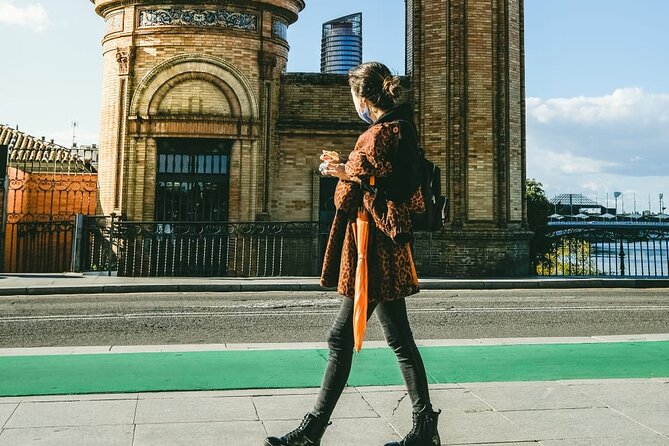
Next you’ll visit a smaller church tied to one of the most important religious festivities, Holy Week. The tour explains that this chapel is associated with the most beloved brotherhoods of Triana, and that it remains a must-stop for anyone visiting the suburb.
This is where Triana stops feeling like a geography lesson and starts feeling like a community with rituals. Even if you’re not traveling during Holy Week, the story helps you understand why the neighborhood is emotionally connected to religious traditions. You’ll likely spot symbolism and feel the sense of continuity the guide is pointing out.
If you’re curious about how religion operates socially, not just spiritually, this part works well. It’s less about memorizing dates, more about understanding what people build together over time.
Real Parroquia de Señora Santa Ana: Mudéjar Style and the Cathedral of Triana
The final stop is the Real Parroquia de Señora Santa Ana, where you’ll learn about its importance as the first church built after the Christian conquest of 1248. The tour also highlights its Mudéjar architecture style, sometimes referred to as the Cathedral of Triana.
This ending is smart. You finish with a major landmark that ties together the themes you’ve been hearing: conquest, architectural style, faith, and Triana identity. By the time you reach this church, you’ve already walked through the river logic, the craft logic, and the religious logic, so the building feels like a conclusion instead of just another stop.
Architecturally, Mudéjar style is a good topic for travelers because it represents cultural overlap in material form. It also makes your photos more meaningful, since you’ll know what features to look for beyond decoration.
Guides Who Turn Streets Into Stories: Marta, Miguel, and Clara
A big part of why this tour scores well is the human factor. You might meet guides like Marta, who explains the river and Triana connections clearly while keeping a lively tone. You could also hear history framed in a broader way from someone like Miguel, who mixes European history with a sense of how to view current events through the prism of the past. And if you’re lucky enough to get Clara, expect an energetic, fun approach that keeps the pacing smooth rather than heavy.
What you should take from this, as a traveler, is simple: your guide is part of the value. With a small group, you can ask something specific, like how a particular era affected everyday life in Triana, and get a real answer while you’re standing in the right spot.
If you prefer tours that feel like a conversation, this setup is a good match.
Price and Value for a 1.5-Hour River-to-Triana Walk
The price is about $30.04 per person for around 1 hour 30 minutes. That might sound small, and in a good way. You’re paying for guided access to multiple meaningful sites plus the context that would take you much longer to piece together on your own.
Here’s the value math I see: you get a sequence that moves across major themes, river defense and trade logic, cultural coexistence, engineering connections, markets and crafts, and then two key religious stops plus the Mudéjar church ending. Most independent travelers can visit these places, sure, but the guide helps you understand what to notice, and in which order. With a time-limited trip, that’s what turns a scatter of stops into a coherent experience.
If your goal is simply to tick off landmarks quickly, a self-guided walk could work. But if you want the why behind what you’re seeing, this guided format gives you more return per hour.
Timing, Getting There, and Where You’ll Finish
You can start either in the morning or the afternoon, which is great for planning. The start point is clearly set at Torre del Oro in the historic center, and you end at Real Parroquia de Señora Santa Ana. That finish matters. You’re not wandering back across town to end where you started, you’re ending in Triana, right where you might want to keep exploring.
The meeting and ending points are also practical for getting around since the tour is near public transportation. Still, you’ll want to think about how you’ll connect afterward. Since the walk ends at a church in Triana, it’s a convenient handoff to dinner and neighborhood stroll time.
If you’re the kind of traveler who likes a plan but also likes to wander afterward, this route structure is handy.
Who This Tour Suits Best, and Who Might Skip It
This tour fits you if you want a history-forward walking experience without committing to a full-day plan. It’s also a good choice if you care about how art and faith show up in ordinary streets and local products. And if you’re traveling with limited time but want a real sense of why Triana is different from central Seville, the river-based approach helps a lot.
It may not be the best fit if you dislike guided listening. There are multiple stops, and the explanations are the point. Also, if you want long stays inside buildings or deep archaeological-style detail, the time window will feel tight.
Should You Book the Seville Triana Quarter and River Tour?
Yes, I’d book it if you want a focused way to understand Seville through the lens of the river and Triana. The small group cap makes it feel personal, and the mix of topics, market and ceramics, bridge engineering, Castle of San Jorge, Holy Week connections, and Mudéjar church architecture, keeps the walk from turning into the same sightseeing script.
One more smart move: book ahead if you can. On average, this tour is booked about 28 days in advance, which suggests it’s popular during peak travel windows. If your dates are fixed, don’t wait until the last moment.
If you’re planning your first serious Seville trip, this is a strong use of 1.5 hours. It gives you a story you can carry into the rest of your days in town.
FAQ
How long is the Seville Triana Quarter and River small-group walking tour?
It runs about 1 hour 30 minutes (approx.).
How many people are in the group?
The tour is capped at a maximum of 10 travelers.
What language is the tour offered in?
The tour is offered in English.
Are there different start times?
Yes, you can choose between morning and afternoon start times.
Where do we meet, and where does the tour end?
You meet at Torre del Oro (Torre del Oro, P.º de Cristóbal Colón, s/n, Casco Antiguo, 41001 Sevilla, Spain). The tour ends at Real Parroquia de Señora Santa Ana (Párroco don Eugenio, 1, 41010 Sevilla, Spain).
Do I get a mobile ticket?
Yes, it includes a mobile ticket.
What places are included on the walk?
You visit multiple Triana and riverfront stops, including the Torre del Oro area at the start, a watchtower built over 800 years ago, a modern monument, Seville’s bridge connection to Triana, a traditional market, areas tied to local crafts and ceramics, the Castle of San Jorge, a church connected to Holy Week, and the Real Parroquia de Señora Santa Ana.
Is this tour suitable for most travelers, and are service animals allowed?
Most travelers can participate, and service animals are allowed.
What is the cancellation policy?
Free cancellation is available. You can cancel up to 24 hours in advance of the experience for a full refund.
More Tour Reviews in Seville
Not for you? Here's more nearby things to do in Seville we have reviewed



More Triana Quarter Experiences worth a look.
 ★ 4.6Live Flamenco Show at “Teatro Flamenco Triana”From $283,290 reviews
 ★ 4.8Baraka Sala Flamenca Show with Drink in TrianaFrom $321,761 reviews
 ★ 4.8Traditional Flamenco Show in TrianaFrom $261,580 reviews
 ★ 5.0Spanish Cooking Class & Triana Market Tour in SevillaFrom $90760 reviews
 ★ 4.93.5-Hour Spanish Cooking Class & Triana Market TourFrom $88751 reviews
 ★ 4.5Flamenco Show Tickets to the Triana Flamenco TheaterFrom $30599 reviews
 ★ 5.0Baraka Triana. Flamenco show with drinkFrom $32497 reviews
 ★ 4.6Flamenco Show at Tablao Almoraima in TrianaFrom $28483 reviews
Continue by place or experience