
REVIEW · SEVILLE TOURS
The Seville of the 3 Cultures
Seville has four eras in one walk. This 2-hour Seville of the 3 Cultures route threads Roman, Al-Andalus and Almohad power, the Christian reconquest, and the Jewish legacy through tight lanes and major squares, with quick story stops at landmarks like the Giralda area and the walk-ending Torre del Oro. You get a mobile ticket and a small group set-up (max 20), which helps the guide keep the pace lively without turning it into a stampede.
I especially like the way the tour connects places you can photograph with the human stories behind them. Two moments that stick with me are the “city layout” lesson from the Ayuntamiento square, and the quick, memorable beats around the Jewish Quarter lanes that make Santa Cruz feel like a living map.
One consideration: you move fast. Most stops are brief, and a few sights list admission as not included, so if you want deep interior time at those places, you will need to plan that separately.
Key highlights you will feel right away
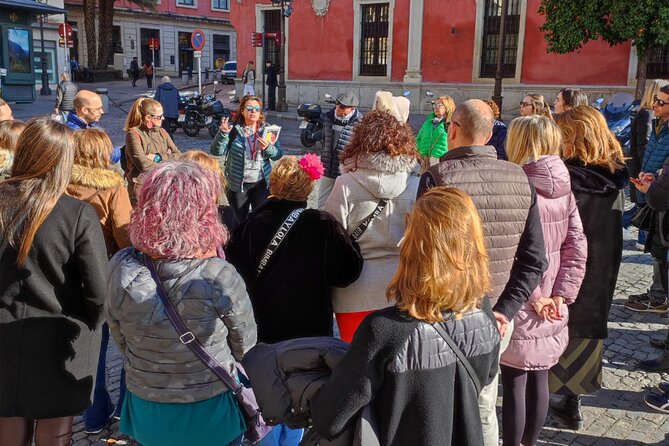
- Max 20 people keeps the walk friendly and easier to hear
- Roman to Christian to Jewish to Muslim traces are explained where you actually stand
- Giralda and cathedral area viewpoints come with practical picture tips
- Santa Cruz and Judería squares give you the lay of the land, not just random sightseeing
- Triana and the river finish make the end of the tour more satisfying than a midtown stop
Where the tour starts, and how to get your bearings fast
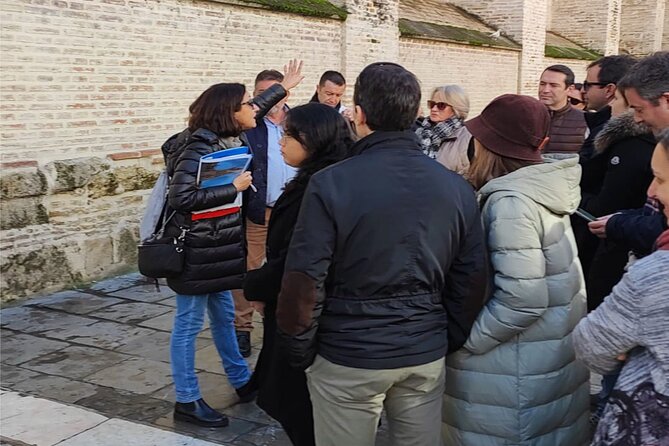
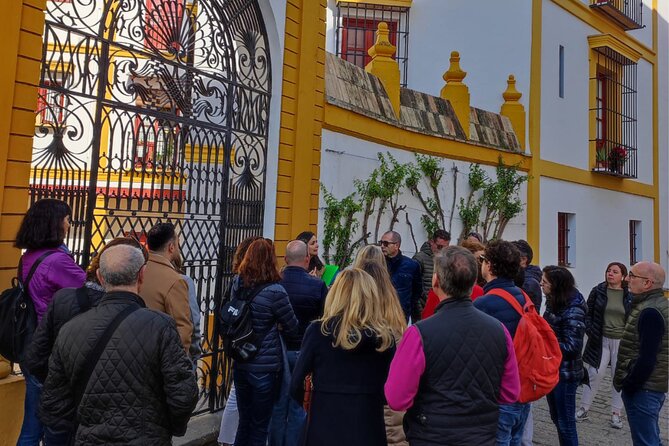
Your walk begins at Plaza de San Francisco (Pl. de S. Francisco), 17, in Seville’s historic center. From the first minutes, the guide’s job is to give you a mental map so you stop feeling lost among the lanes. That matters here, because Seville is famous for looking like a maze, and a guided route helps you turn the maze into a story.
Expect the tour to feel like a sequence of small “time windows.” Each stop is short, usually around a few minutes, so you are collecting details as you go rather than lingering in one spot for long. For me, that works best on the first or second day in Seville. You get oriented, you learn what to pay attention to later on your own, and you leave with a short list of places you might want to revisit.
Also, you are not paying separately for many photo stops. The experience lists most sites as free admission, with a handful of notable exceptions where admission is not included. That is a key value point if you like a mix of landmarks and neighborhood texture.
You can also read our reviews of more tours and experiences in Seville.

Ayuntamiento de Sevilla to Puerta del Perdon: reading Seville’s city plan
The first big geography lesson comes at Ayuntamiento de Sevilla. This is the square that effectively divides Seville into two worlds: the older commercial area around streets like Calle Sierpes, and the more monumental zone. If you have only ever seen Seville from postcards, this stop helps you understand why the city feels different block to block. It is not random. The city’s shape reflects centuries of shifting power and movement.
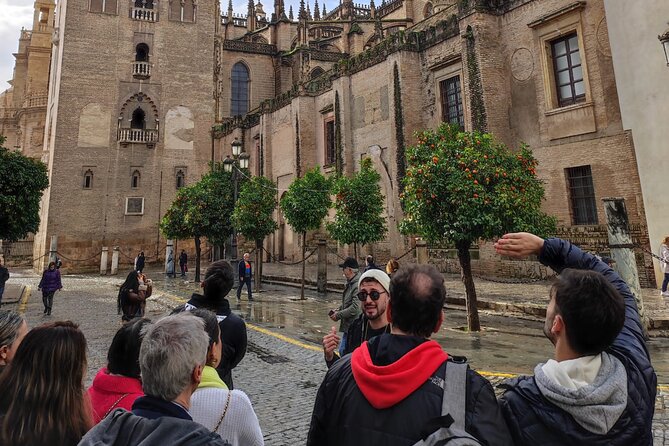
Then you head toward Puerta del Perdon. This is where the tour leans into legends and dramatic building history. You also get a specific photo focus, including a moment around the collapse of the Giralda and how to frame it for the best picture. Even if you are not a history nerd, this is the kind of guidance that makes your phone camera feel smarter.
The upside of these first stops is that they settle your biggest question fast: where are you, and what parts connect? The possible drawback is that if you arrive late or keep checking your phone, you can miss the early “map-setting” explanations that make the rest of the tour click.
Plaza de la Virgen de los Reyes: the cathedral area, but with answers
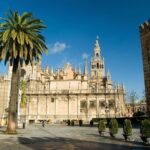
At Plaza de la Virgen de los Reyes, you are in the orbit of the Cathedral attached to the Giralda. This is a must-see area in Seville. The difference on this tour is that you are not just told what it is, you are prompted to notice what you usually do not notice.
The tour description points to the idea of seeing what you do not see. That usually translates on the ground into quick prompts like where to look, what kind of finishing you are looking at, and what kind of era layers show up in the way the site developed. If you have ever stood in front of a huge church and felt like you were just waiting for the next stop, this kind of direction can change the whole visit.
No admission is listed for this stop, so you can enjoy it even if you are not ready to pay for interiors.
Palacio Arzobispal: when the Church’s story gets unsettling
Next is Palacio Arzobispal. The description gives a strong clue: the tour frames the place in terms of the Archbishopric’s power dynamics, with a story that is described as an eerie kind of contrast between importance and community life.
A practical note: admission is listed as not included here. So what you will experience depends on what parts are accessible without entry. If you only have two hours total, treat this as a viewpoint and storytelling stop, not a full interior visit.
This stop is still valuable because it adds balance. It is easy to focus on grand facades and ignore the social side. Here, you get a sense that power in Seville was not just architectural. It affected daily life.
Santa Marta and the squares of the Judería
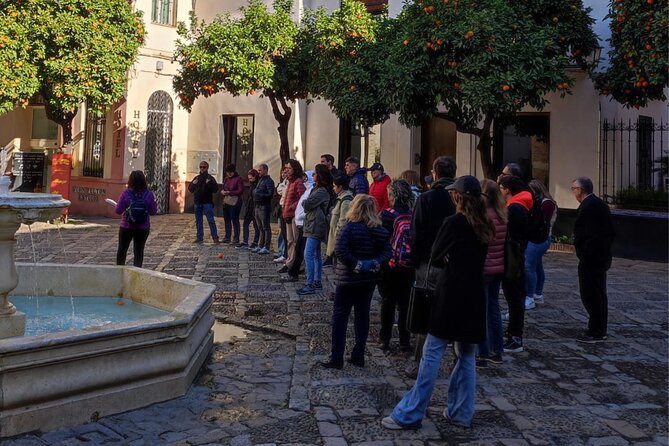
The tour then goes into the neighborhood where Seville’s Jewish legacy becomes visible in the street layout itself. You visit Plaza de Santa Marta first, described as a hidden square where you get a story about one of the largest Jewish communities Seville had.
From there, you move to Plaza de la Alianza, a square tied directly to the old Jewish Quarter. The idea here is that the square feels like a sum of many passed villages, because Seville developed through multiple waves and communities. In other words, you are looking at geography that remembers migration.
Finally in this section, you reach Plaza de Doña Elvira, which is framed as a place for sharp photos in the Santa Cruz neighborhood, plus stories about minorities and their unusual superstitions. That part can sound abstract on paper, but on the ground it tends to land well when the guide ties it to a specific corner, street angle, or building presence. It gives you something to picture, not just something to know.
All three of these stops list free admission, which is great if you want the neighborhood feel without paying extra at every turn.

Calle Susona and Calle Vida: the street legends angle
Now you hit two lanes that the tour treats like legends in motion.
Calle Susona is described as the big neighborhood legend. The guide is expected to use a sensory approach, with a rhythmic, story-like delivery. Even if you do not catch every detail, you will feel how stories shaped how people remembered the neighborhood.
Then comes Calle Vida, paired with a playful thought: if there is a Vida street, there is also a Muerte street. The tour positions it as a surprise waiting moment, and that works because Seville’s old districts often contain tiny clues of darker or stranger tales in the way places are remembered.
One drawback here is also the nature of legend stops. If you dislike mystery-style storytelling, this section may feel more theatrical than factual. For most people, though, legends are still useful. They tell you how locals understood the past, even when written records are incomplete.
Judería and Plaza del Patio de Banderas: where the walk links to power
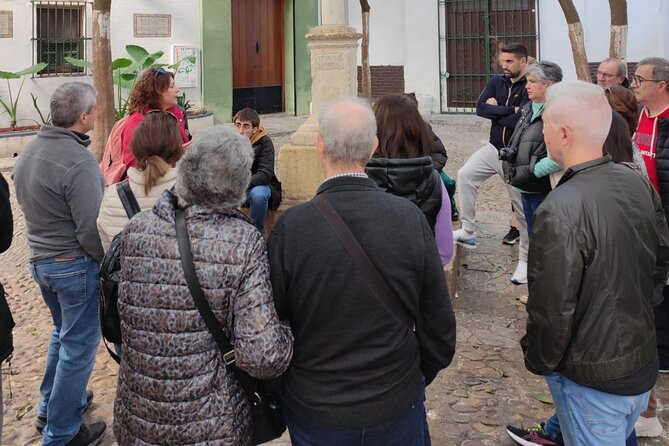
After the lane stories, you enter Judería, described as an area where, after the tour, you will dream in colors, flavors, smells. You should not interpret that as a promise that a restaurant opens mid-walk. It is more about the idea that the neighborhood gives you sensory memory. Old Jewish Quarter streets often smell like wood, coffee, and warm stone in the afternoon light, and the layout can make you slow down even when the schedule keeps moving.
Then you step into Plaza del Patio de Banderas, tied to centuries of history connected to the Royal Alcázars of Seville. This is a smart move in a two-hour tour because the Alcázar site is a top attraction, but most visitors only know it as a single visit. Here, you get the idea of succession and what different powers left behind.
This is also where the tour’s “three cultures” focus feels practical. You see how Islamic-era influence can sit next to later Christian power, not as a museum timeline, but as physical layers in the same city.
Puerta del Leon and Archivo General de Indias: symbols and records
Two stops bring you into the era of empire and administration.
Puerta del Leon is framed with symbology, defense, heraldry, and the customs of different kings who passed through its walls. It is a reminder that in medieval cities, walls were not just for protection. They were political statements you walked past every day.
Admission is not included here, so treat it as an exterior stop unless you plan to pay for entry elsewhere.
Then comes Archivo General de Indias, described as a place where even pirates seem connected to the story because the archive is what was kept and protected. You are not being asked to imagine a movie scene. You are being guided toward the idea that empires create paperwork, and paperwork creates history. The archive becomes a symbol of control and preservation.
This stop also lists admission as not included, so it is about context as much as access. Still, it is a strong pairing with the nearby monument area because it shifts your attention from architecture to what people actually used the city for.
Monumento a la Inmaculada Concepción, Giraldillo, and Torre Abdel Aziz
Next you move into a trio of stops that help you see Seville’s visual language more clearly.
At Monumento a la Inmaculada Concepción, the tour connects Seville to painters and artists, Baroque influence, and an interesting claim about the first marketing campaign in history. That kind of detail is not meant to prove a debate. It is meant to make you look around and remember that cities market themselves through art, religion, and public messaging.
Then you reach Giraladillo, described as a great icon you must see and nearly touch, with a warning that the view can deceive. That is a great line to remember. In Seville, perspectives can fool you because of camera angles and the way tall structures compress space.
Finally you go to Torre Abdel Aziz. The guide role here is photo-thinking, pointing out photo places and helping you feel the greatness of towers and walls, plus palaces and beautiful houses. The goal is to help you take better pictures, yes. More importantly, it helps you understand why towers and walls dominate the skyline.
All three are listed as free admission. That is a value win, because tower-and-monument views can be the most expensive part of some tours elsewhere.
Arco del Postigo del Aceite to Plaza del Cabildo: the river quarter mood
After the tower focus, you move into the Arenal area and toward the river.
Arco del Postigo del Aceite is described as straight out of stories, with the Arenal Quarter having everything a little, good and bad. This is a good tone shift. You move from symbols and monuments into the daily-feeling parts of town where Seville’s character changes with the light.
Then you reach Plaza del Cabildo, which the tour frames as a must-pass square if you do not want to leave feeling like you missed the point. It is described as beautiful and full of explanation about how it was lived and why you might feel you only stayed halfway elsewhere. That kind of language is dramatic, but it usually works because Plaza del Cabildo gives you a sense of old-city administration and movement.
Soon after, you can stop at Mercado Artesanía El Postigo. The tour treats it as a place where they keep the best of each of the villages that settled here. You should use this stop as a quick culture checkpoint. Browse, pick up a small item if you want, and use it as a reset before your final stretch.
These are mostly free admission stops, so they keep your cost down while still delivering neighborhood texture.
Puente de Isabel II to Torre del Oro: ending in Triana’s shadow
The finale pushes you across the river.
Puente de Isabel II (Puente de Triana) gives you time for photos and comparisons, plus pilgrim stories of the characters who crossed. Even if you are not sure what a pilgrim story will mean until you hear it, the bridge itself is a powerful “Seville after-hours before-hours” connector. It shows you how Triana and the older center face each other.
The tour ends at Torre del Oro, with the description emphasizing symbology and the feeling of realizing you have understood Seville more clearly by the time you reach the tower. Admission is not included at Torre del Oro, so you will likely get the best value from it by focusing on the views, the river presence, and the photo angles rather than expecting an interior visit.
This ending location is smart. Many tours end in a random square. Here, finishing at the river gives your last 10 minutes a sense of arrival.
Price and value: why $13.88 can work
The price is listed at $13.88 per person for about 2 hours. That is strong value for a route that covers major landmarks, neighborhood squares tied to multiple cultures, and a logical sweep from the historic center toward Triana.
Here is what you are paying for, in practical terms:
- Planning help so you do not waste time figuring out a “three cultures” route yourself
- Guided context so you understand why each place matters, not just what it looks like
- A tight schedule that still covers a lot of ground, including the river ending at Torre del Oro
The only way the value drops is if you expect every listed stop to turn into a full paid attraction. A few sights have admission not included, like Palacio Arzobispal, Puerta del Leon, Archivo General de Indias, and Torre del Oro. If you want to go inside all of them, you will likely spend more on top.
But if you want the stories and the street-level Seville feel in one organized walk, this price makes sense.
Also, the tour is often booked about 27 days in advance, which is a hint to reserve early if you are traveling in a peak window.
Who this tour suits best (and who should plan differently)
This Seville of the 3 Cultures tour suits you if:
- You want a first-day orientation to Seville’s neighborhoods
- You like storytelling tied to specific places, especially Santa Cruz and the Judería area
- You want a compact walking plan that ends with river views instead of turning back early
Plan differently if:
- You hate walking fast or you want long museum-style stops
- You want multiple paid interiors in one outing, because several stops list admission not included
- You are very sensitive to crowds in the historic center, even with max 20, because the route runs through popular zones
The group size max of 20 is a good sign for hearing the guide and keeping your pace comfortable.
Guide style and what the praise tells you
The overall rating is 5 across a small set of reviews. The praise themes are consistent: people love the neighborhoods being placed in context and guides being engaging and professional.
Two guide names show up in the comments: Alfredo and Jose. The common thread is that they make the walk more fun and meaningful by explaining the area and telling stories in an easy way. Even if your guide is someone else, those reviews suggest you should expect lively narration rather than a quiet lecture.
Should you book Seville of the 3 Cultures?
I think you should book this tour if you want a time-efficient way to understand Seville as a city shaped by Roman, Muslim, Christian, and Jewish influences, with a route that keeps you moving through the exact neighborhoods where those layers show up. The price is reasonable for what you get, especially the combination of landmark views and the Jewish Quarter-focused squares.
I would skip or rethink it only if you want long stays inside major buildings. This is a walk for stories, photos, and street-level context, not a ticket-to-everything plan.
If you do book it, wear comfortable shoes, keep your phone charged for Giralda and river photo moments, and treat the two hours as your “map and mindset” for the rest of Seville.
FAQ
How long is the tour?
It runs for about 2 hours.
What is the price per person?
The price is $13.88 per person.
Is it a mobile ticket tour?
Yes, it uses a mobile ticket.
Are admission tickets included for all stops?
Most stops are listed as free admission, but a few sites say admission is not included, including Palacio Arzobispal, Puerta del Leon, Archivo General de Indias, and Torre del Oro.
Where does the tour start and end?
It starts at Pl. de S. Francisco, 17, Casco Antiguo, 41004 Sevilla, Spain, and ends in the Torre del Oro area at P.º de Cristóbal Colón, s/n, Casco Antiguo, 41001 Sevilla, Spain.
What is the cancellation policy?
Free cancellation is available up to 24 hours in advance for a full refund.
If you cancel less than 24 hours before the experience starts, the amount you paid is not refunded.
More Tour Reviews in Seville
Not for you? Here's more nearby things to do in Seville we have reviewed


More Seville Tours worth a look.
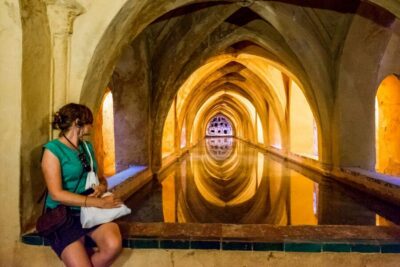 ★ 4.6Royal Alcázar Entry TicketFrom $2328,378 reviews
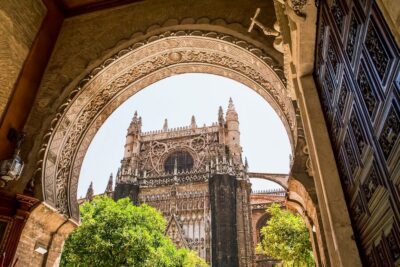 ★ 4.5Cathedral and La Giralda Entry TicketFrom $2024,592 reviews
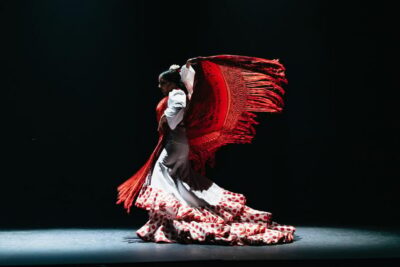 ★ 4.7Live Flamenco Dancing Show Ticket at the TheaterFrom $2716,396 reviews
 ★ 4.21-Hour Guadalquivir River Sightseeing Eco CruiseFrom $1910,281 reviews
 ★ 4.7Cathedral, Giralda, and Royal Alcázar Guided TourFrom $699,165 reviews
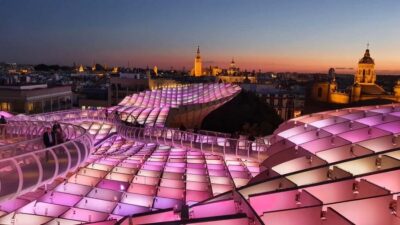 ★ 4.6Setas de Sevilla Entry TicketFrom $188,901 reviews
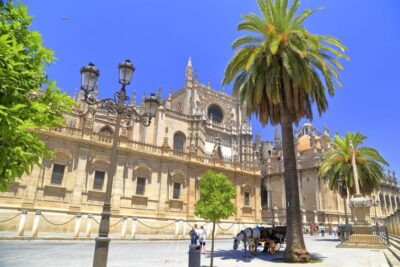 ★ 4.6Cathedral, Giralda & Alcazar Entry With Guided TourFrom $658,560 reviews
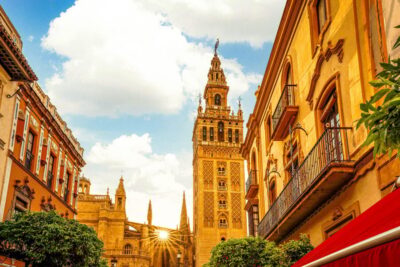 ★ 4.8Priority Access Cathedral, Giralda & Alcázar TourFrom $647,563 reviews