
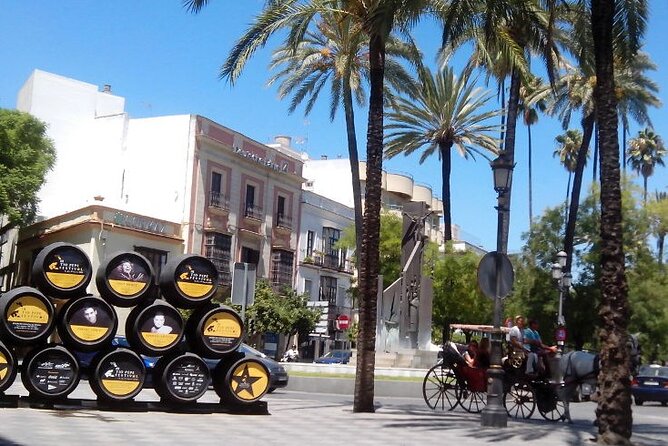
REVIEW · CáDIZ TOURS FROM SEVILLE
Walking tour in Jerez
Jerez works fast on foot. In this 2-hour historic-center walk, you get a clear, human-scale sense of how Jerez became Jerez, with stops tied to the city’s changing cultures and power. I especially like the small group size (max 6) and the way the guide keeps the story moving, with plenty of chances to ask questions. The main catch: Alcázar and the Cathedral are shown from the outside, so if you want to go in, you will likely need separate tickets.
You’ll meet in the old-town area near Plaza del Arenal, and then you’re guided through the streets and perspectives that shape the city today. Expect palaces and major buildings from different eras, plus narrow lanes and shady corners that make the walk feel comfortable even when the sun is up. Service animals are allowed, and the tour format is built so most people can participate.
Key Highlights You Should Know Before You Go

- Max 6 travelers means more time for your questions and a less rushed feel
- German guided tour gives you a structured story of Jerez, not just facts on walls
- Alcázar and Cathedral outside views help you orient quickly without lining up
- Three-part history flow breaks the city’s past into digestible chunks
- Sherry, horses, and flamenco context connects the everyday city to its signature traditions
- Mobile ticket makes it easy to show up and start the walk
A Historic-Center Walk That Helps You Read Jerez Fast
Jerez can feel bigger than it looks at first. The streets are charming, sure, but the real magic is in understanding what shaped them. This walk is designed for that goal: you cover the historic center in about two hours, so you leave with a working map in your head and a sense of why the city looks the way it does.
The value here is the structure. You do not just wander. You get a guided “story route” that moves through Jerez’s past in clear sections. That matters because Jerez has layers. You can see it on the streets, in the architecture, and in the rhythm of daily life. A short guided walk gives you the shortcuts so you’re not stuck trying to decode everything on your own.
You can also read our reviews of more tours and experiences in Cadiz.



Meeting at Plaza del Arenal, Then Getting Oriented on Foot
The tour starts at ATM Santander, Pl. del Arenal, 5, 11402 Jerez de la Frontera, Cádiz, Spain, with a start time of 11:00 am. That is a helpful anchor point because you are starting in the old-town area, close enough to key landmarks that the walk actually feels like a journey through the historic center.
What you should expect next is an easy transition from modern street life into older Jerez. The guide frames what you are about to see, then points you toward the details you might miss if you were just walking. In places like Jerez, tiny choices matter: a change in street direction, a view opening up, a building form that hints at a different era. A guide’s job is to help you notice these without turning it into a lecture.
You are also working within a small group cap of six. That changes the experience. The guide can adjust pace when someone is reading a plaque too closely, or when a question needs a real answer. It also makes it easier to keep track of where you are going.
Alcázar and Cathedral From the Outside, and Why That Still Works
One of the included highlights is seeing Alcázar and the Cathedral, but both are listed as not included inside. So, you are viewing them as major landmarks rather than paying for interior access during this walk.
That might sound like a drawback, but it’s often a smart trade. In two hours, you do not have time to manage entrances, lines, and the slow pace you naturally get inside these kinds of buildings. By focusing on the outside, you still get the big visual anchors. You learn what to look for, then you can decide later if you want to go in on your own time.
Here is how to think about it. If you want an orientation walk with context, this version is strong. If you specifically want to spend time inside major sites, plan to add that separately after the tour. Either approach can fit your travel style, but you just need to know what the tour is set up to do.
The Three-Part Jerez History Story, Stop by Stop
The tour’s stops are built around a clear idea: an overview of the history of Jerez, broken into multiple segments. Even without long museum-style detours, you still get a sense of how the city formed and what influenced the way people live there now.
Segment 1: Getting the big picture early
You start with the broad timeline. You will likely hear how Jerez grew into its role in the region, and you will connect major buildings and street layouts to the eras they represent. This early framing is useful because it gives you something to hold onto while you walk. Instead of collecting random impressions, you’re building a mental map.
A practical benefit: you can walk faster. If you know what you are seeing and why it matters, the walk feels lighter. You spend less energy guessing, more energy noticing details.






Segment 2: Major landmarks and shifting styles
The middle of the walk leans into the kind of architecture that signals different periods. When you look at a city like Jerez, style shifts are not just pretty design. They often point to changing rulers, changing wealth, and different cultural influences.
This is where the outside views of Alcázar and the Cathedral likely become especially helpful. Even standing at street level, you can start to read the city’s evolution. If you’re the type who likes to understand what is behind the look, this segment will feel like the payoff.
Segment 3: How history connects to daily culture
The last segment ties the historical background to the lived identity of Jerez. This is where the tour connects the dots between Jerez and its signature themes: sherry, horses, and flamenco.
It is not just trivia. The point is to help you make sense of what you will see later, whether that is a bodega, an equestrian scene, or a flamenco performance. When the guide explains the connection, you walk away with context that makes the rest of your trip easier.
Sherry, Horses, and Flamenco, the Connections That Make the City Click
Jerez has a reputation, but reputation can be vague. This walk helps you turn it into something concrete. You learn how Jerez is tied to sherry culture and why the city’s traditions and atmosphere connect to that identity. You also get the link to horses and flamenco, which are often treated as separate topics unless you understand Jerez as a whole.
What I like about this approach is that it gives you choices for the rest of your time. After the walk, you can decide what to pursue next based on what resonates.
- If you care most about sherry, you now have a clearer reason to seek out a bodega visit.
- If you prefer culture and performance, the flamenco connection helps you choose the right kind of evening.
- If you like movement and tradition, the horse link makes the equestrian side of Jerez feel less like a postcard and more like a living part of the city’s story.
You may also get recommendations during the walk. In the feedback shared with this tour concept, guides like Andreas were praised for taking time to answer questions and for going beyond what you expect from a typical city walk. Another guide mentioned, Caroline, also stood out for the same reason: giving the city a readable voice instead of just a list of stops.
What the Guide Does That Changes Everything
A guided walk lives or dies by the guide. Here, the repeated praise is consistent: friendliness, strong communication, and answers that actually satisfy your curiosity.
Guides such as Andreas have been singled out for being approachable and for supporting the tour with real explanation, not just background noise. One detail that comes up in the feedback is that the guide can handle questions well, and even expand the experience by offering relevant next steps, including more sherry-focused time right afterward. Another guide named in the feedback is Caroline, praised as a must-do for a Jerez weekend because she helps you get oriented quickly and understand what makes the city feel authentic.
That authenticity is not a marketing word here. It’s practical. When a guide connects history to what you see outside, you start to feel like you understand the city instead of sightseeing from the surface.
Pace, Weather Sense, and How to Use This in Your Itinerary
The tour lasts about two hours, which is a sweet spot for many travel days. It works if:
- you arrive and want fast orientation
- you want a low-commitment activity that still feels meaningful
- you plan more serious time later, like a site visit or a sherry stop
In terms of pace, you should expect a walking rhythm that matches a historic center without turning it into a full-day grind. The route is described as including narrow streets and cozy shaded places. That matters because Jerez can get warm, and shady breaks are not just pleasant, they keep the walk comfortable.
Also, the group cap of six helps. Smaller groups often feel more flexible, and you are less likely to feel like a passenger in a long line. For me, that is one of the best “quality indicators” for this style of tour.
Price and Value: What $45.10 Really Buys You
The listed price is $45.10 per person, with a guided tour in German and outdoor views of major landmarks. On paper, that can look like a lot if you compare it to cheap walking tours. But the value comes from three things you can feel during the experience.
First is the guidance quality. You are not paying for someone to point. You’re paying for a structured explanation and an interactive Q and A flow, which the feedback emphasizes again and again.
Second is the time efficiency. Two hours in Jerez’s historic center can replace a lot of guesswork. If you’re the type who wants to get bearings fast and avoid wandering without direction, this is a practical use of money.
Third is the small group size. Max six travelers means you are more likely to get personal attention, and the guide can maintain momentum without constantly stopping and restarting for a crowd.
One more consideration: entrance fees are not included. That means your cost is the tour only. If you want to go inside Alcázar or the Cathedral, factor in separate ticket time and money. If you do not care about interiors, this is a cleaner purchase because you focus on the outside landmarks and the story behind them.
If You Want More Than the Outdoors, Plan Your Next Step
Because Alcázar and the Cathedral are not included inside, you may want a follow-up depending on your interests.
Here’s the approach I recommend:
- Do the walk first for orientation and context.
- Then decide on interiors later, based on what stood out to you during the history story.
This is exactly where guided clarity pays off. When you already understand what you are looking at, a return visit inside becomes more rewarding. You can focus on what matters rather than trying to learn everything at once.
If sherry is a priority, this tour also sets you up well for bodega time afterward. The concept of pairing the walk with sherry-focused follow-up comes through in the tour feedback, including praise for a bodega component right after the city walk.
Who This Tour Suits Best
This walking tour is a strong fit for:
- first-timers in Jerez who want a quick, readable overview
- people who prefer guided history without museum fatigue
- travelers who want context for sherry, horses, and flamenco before choosing activities
- small-group travelers who like asking questions and getting direct answers
It may not be the best fit if:
- you only want interior access to major sites during your tour
- you expect a long, deep architectural walkthrough without outside views or street-level context
Should You Book This Jerez Historic-Center Walk?
If you have a limited schedule, this is the kind of activity that saves you time and turns your day into something you can interpret. The route is built for getting oriented fast, learning why Jerez has its distinct personality, and connecting the city’s most famous traditions to the places you see.
Book it if you want an easy win: a short guided walk in a small group, with German guidance and a history story that stays relevant to modern Jerez. If you dream of going inside Alcázar or the Cathedral, plan those entrances as a separate add-on.
One final practical tip: since it starts at 11:00 am, think about heat and energy. Start early enough and you’ll enjoy the shaded street moments more. And if you care about sherry or performances, go into the walk with a question or two in mind. A good guide like Andreas or Caroline will help you connect the answers to what you see next.
FAQ
How long is the Jerez walking tour?
The tour lasts about 2 hours.
What is included in the ticket price?
You get a guided tour in German, plus stops to see the Alcázar and the Cathedral from the outside and the nearby historical center.
Are entrance tickets to the Alcázar or Cathedral included?
No. Entrance to the sights is not included.
What time does the tour start?
The tour starts at 11:00 am.
Where is the meeting point?
The meeting point is ATM Santander, Pl. del Arenal, 5, 11402 Jerez de la Frontera, Cádiz, Spain.
What is the group size limit?
The tour has a maximum of 6 travelers.
Do I need a printed ticket?
No. It uses a mobile ticket.
Can I cancel for free?
Yes. You can cancel up to 24 hours in advance for a full refund.
More Tour Reviews in Cadiz
Not for you? Here's more nearby things to do in Cadiz we have reviewed











More Cádiz Tours from Seville worth a look.
 ★ 4.1Cadiz: City Sightseeing Hop-On Hop-Off Bus TourFrom $32753 reviews
 ★ 5.0Walking Tour through Cádiz: Stories from the hand of a local guideFrom $16532 reviews
 ★ 4.6Cádiz: Sunset Catamaran Cruise ToursFrom $29498 reviews
 ★ 4.5Andalusian Horses Dance ShowFrom $33483 reviews
 ★ 4.7English Cádiz Tour: Walking Tour with Local GuideFrom $15431 reviews
 ★ 4.6Cadiz: Medieval TourFrom $38379 reviews
 ★ 4.4Cádiz: Bay of Cádiz Catamaran Tour with HostFrom $22327 reviews
 ★ 4.5Sancti Petri: Sunset Catamaran CruiseFrom $24277 reviews
Continue by place or experience