
REVIEW · SANTA CRUZ & SEVILLE JEWISH QUARTER
Seville Jewish Quarter Small Group Tour with Tapas and Drinks
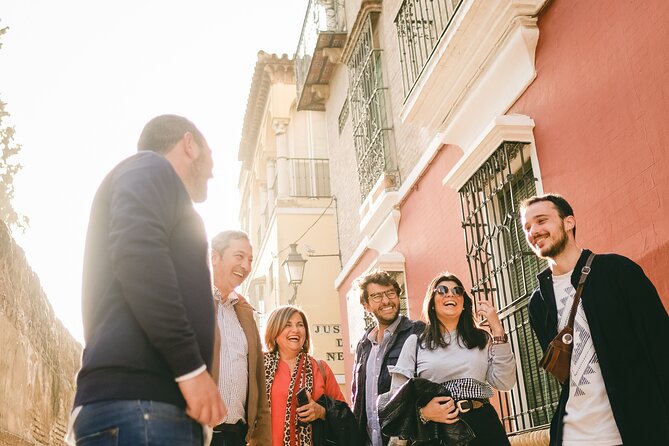
Seville’s Jewish stories hide in plain sight. I love how this small-group walk turns the streets of Santa Cruz into something you can actually understand, with photo stops built into the route and stories you will not spot on your own.
I also love the ending, because you get a real sit-down tapas meal, with three tapas and two drinks included, not just a snack. One possible drawback: much of what you will learn about the Jewish community has limited surviving physical remains, so the tour leans hard on the guide’s storytelling to make the places click.
Key highlights worth planning for
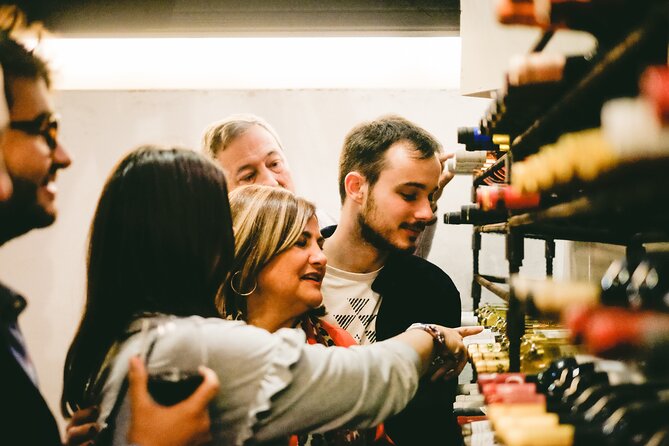
- Small group of up to 10 people, so your guide can actually answer questions.
- Alcazar origins and fortified context, so the neighborhood feels less random and more strategic.
- Susona and the Street of Death, a medieval legend that makes the lanes memorable.
- Cemetery, worship sites, and layered religious history, tied to what you can still see today.
- Three tapas plus two drinks included, with options handled for dietary needs when you book ahead.
How Seville’s Jewish Quarter turns into a story you can walk
This is not a museum-on-a-map tour. It is a slow, street-level way to understand why Seville’s Jewish Quarter (the Santa Cruz area) looks the way it does, and why so many layers overlap here. The best part is the pacing. You stop often enough to catch details, but you do not feel stuck in one spot.
The route starts with the big picture, then shrinks down to the human scale. You start seeing how the neighborhood fits next to the Alcazar area, and how walls, gates, and survival all shaped daily life. And because it is a small group, you are more likely to get answers to the kinds of questions that pop up naturally while you look at old stonework.
The photos are a real bonus. You will find angles that make the narrow streets feel deep, plus small squares and side lanes that look like they belong in a storybook.
You can also read our reviews of more tours and experiences in Seville.



Plaza del Triunfo to the Jewish Quarter, with Alcazar origins on the way in
Your tour begins at Plaza del Triunfo, a central, easy landmark. From there, you get an introduction that helps you set your bearings before you enter the maze of the old quarter. This matters because the Santa Cruz area can feel confusing if you are just wandering and trying to connect streets by memory.
One of the tour’s early strengths is how it links the Jewish Quarter to the broader Alcazar story. Instead of treating the Alcazar like a separate attraction, you get the origin context on your way in. That means when you later discuss fortifications and the relationship between the fortified zone and the neighborhood, it will make sense instead of sounding like a random history lecture.
This section also sets the tone for what follows. You learn how the neighborhood changed over time, and you start training your eyes to notice urban planning choices you would otherwise ignore.
Spotting the urban changes that shaped modern Seville
As you move deeper into the area, the tour turns to urbanistic changes, meaning how the streets and blocks developed and got reshaped. You will hear facts that explain why certain passages feel the way they do, why some routes open up while others feel tucked away, and why the neighborhood gives you those sudden little pockets of space.
This is one of the smartest parts for first-time Seville visitors. It helps you understand that the city you see today is not just old buildings. It is older structures plus repeated renovations, changing boundaries, and shifts in who lived where.
You do not need to be a history expert to enjoy this. The guide keeps it grounded in what you can actually see, so the neighborhood starts to feel legible.
Susona and the Street of Death, the legend that gives the lanes a pulse

Then you get to one of the medieval stories that turns walking into something you remember. The legend of Susona and the Street of Death adds drama to the geography. Even if you are skeptical by nature, it works because the story is used as a lens, not a free-for-all.
This is when the Jewish Quarter stops feeling like a sequence of stops and starts feeling like a lived place with tension, rumor, and danger. You will find yourself looking at the narrow streets as if they were routes people would use for real errands, not just photo backgrounds.
It is also a great section if you like narrative history. The guide connects the myth to the emotional and cultural atmosphere of the area, which makes the later historical points land better.
The fortified area around the Jewish Quarter and the Alcazar
Another recurring theme here is defense and control. The tour explains why the neighborhood sat within an area of fortifications tied to the Alcazar. That is a key point because it changes how you interpret the streets. You start to think in terms of boundaries, access, safety, and power, not just architecture.
When you understand that fortified structure, the neighborhood stops feeling like a leftover. It feels like a designed place that responded to real political realities. This is especially useful in Seville because the Alcazar is so visually commanding. The tour gives you a way to connect that big presence to the smaller streets beside it.





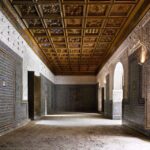
The preserved medieval Jewish cemetery, and the structure that survives
One stop you will not forget is the old medieval Jewish cemetery, preserved in a curious structure. This is one of the most meaningful parts of the evening because cemeteries are quiet evidence, even when the surrounding details are gone.
The tour does not ask you to pretend everything is intact. It acknowledges that physical remains are limited, and instead focuses on how the surviving elements still anchor the story. If you are the type who likes to see how history actually leaves traces, this is where you feel the weight of place.
Even if you wish more stones were visible, the guide’s framing helps you understand why what does survive matters.
Worship across the Mediterranean: three cultures in one place
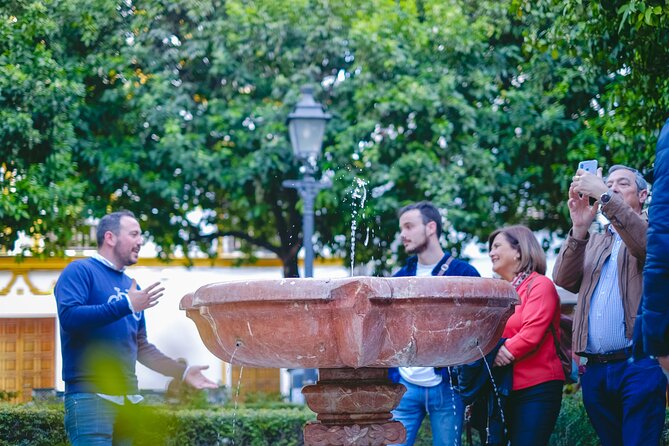
Another stop brings in the idea that the same spot served as a worship place for three Mediterranean cultures. This is where you get a strong reminder that history is not a single straight line.
You are shown how religious and cultural use can shift over time, often leaving behind subtle clues in the way buildings and spaces were repurposed. The tour stays focused on what the location represents and how that layering shaped the community’s lived experience.
For me, this is one of the most respectful parts of the tour. Instead of trying to force a dramatic narrative, it shows how layers overlap in real cities.
A hidden medieval secret preserved inside today’s hotel
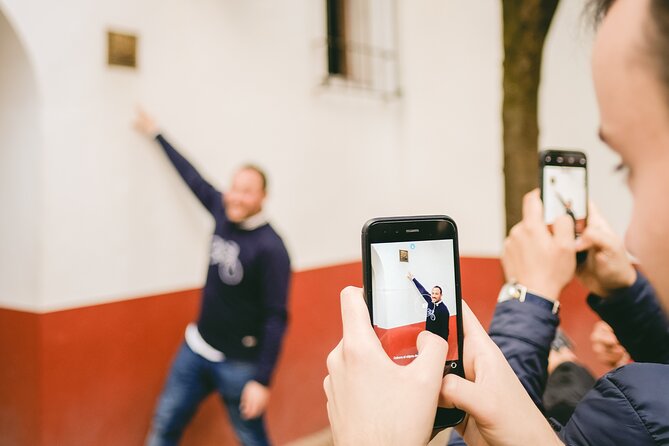
One of the more fun surprises in this tour is the idea of a hidden secret in the Jewish Quarter that is now preserved as part of a hotel. You will hear how the houses in the area hold stories that survived through adaptation.
This is one of those moments where you realize how Seville protects its past, sometimes literally by folding it into present-day spaces. You do not need to book the hotel stay to get value here, but it helps you understand why some streets feel ordinary from the outside while meaning something far bigger underneath.
You get a guided way to notice the difference between what is decorative and what is structural, between what is public-facing and what is quietly preserved.
The square that names the neighborhood, and the first church it became
Every neighborhood has a center, and this one has a square that even carries the identity of the area. You learn about the origin of the first church tied to this square, then how that religious presence transformed throughout the centuries.
This section is useful because it shows you how a community’s footprint can change roles while staying in the same geography. It also helps connect the Jewish Quarter story to the broader Seville religious landscape you will see around the cathedral area later.
When you leave this part of the walk, the neighborhood feels less like an isolated pocket. It feels like part of the city’s long-running conversation about faith, power, and daily life.
Tapas dinner: three tapas, two drinks, and a menu that fits the Andalusian vibe
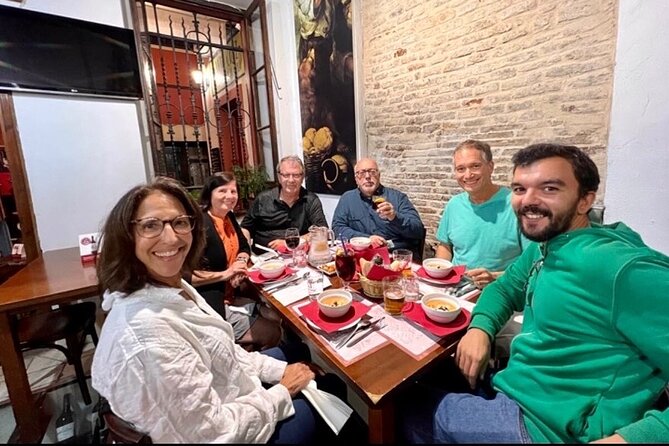
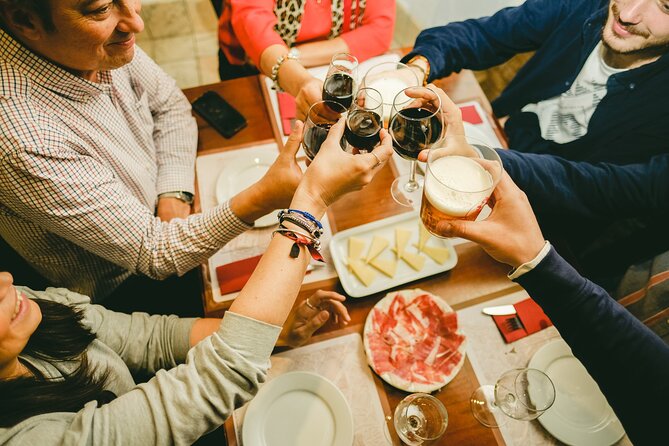
After the walking, you move to a local tapas bar for dinner. Here the tour turns practical in the best way. Instead of sending you off hungry, it builds in the meal time as part of the experience.
You get a meal consisting of three tapas and two drinks included. It is described as a three-course traditional Andalusian spread, and the dishes usually combine vegetables with meat and/or fish. The exact menu changes for each session, but you might see items like salmorejo, croquetas, oxtail, spinach with chickpeas, pisto, pork cheeks, aubergines, anchovies, calamari, gazpacho, and mushrooms.
Two details I think matter for your enjoyment:
- The tapas selection is built to feel like an actual meal, not a token tasting.
- The guide setup and food ordering often make it easier for you to sample without second-guessing.
Food allergies and intolerances are handled with advance notice. You are asked to advise at booking time so the restaurant can be informed. In practice, people have reported good accommodation for gluten intolerance, plus dietary needs like avoiding pork or shellfish.
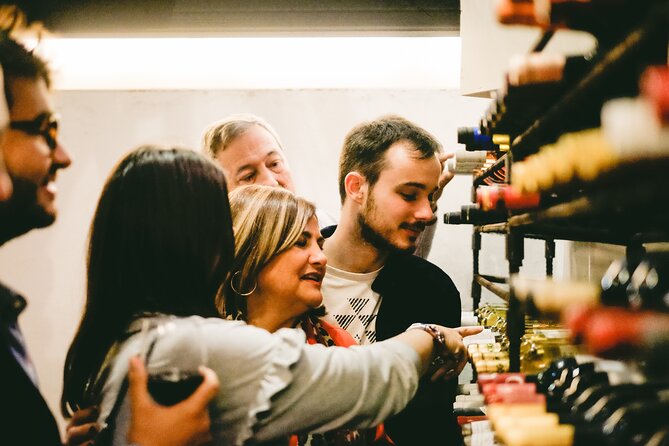
One more thing: this is not a wine cellar tour. You focus on tapas and storytelling, and then you finish chatting with the guide. If you came for history plus food, you are in the right place.
Group size, pacing, and what to bring for a 3-hour evening
This runs about 3 hours total, and the walking portion is often described as around an hour and a half. The good news is that the walk is presented as manageable for most people. Still, you are moving through old streets, so comfortable shoes matter.
Because the group is capped at 10 travelers, the pace feels human. You are less likely to get the feeling of rushing behind a crowd, and it is easier to hear the guide when the street noise rises and falls.
If rain shows up, do not panic. The tour still works in wet weather, but you should pack a light rain layer. Narrow lanes can get slick, and you will be happiest if you stay dry while you photograph.
Also, since you are in the Jewish Quarter area, bring curiosity, not just a camera. The stories make the details click, especially in the moments where physical remains are limited.
Price and value: why $71.35 can make sense in Seville
At $71.35 per person, you are paying for three things at once: a guided walking experience in a historically complex area, a structured tapas dinner, and the small-group format.
The value angle is the food. You are getting a meal with multiple tapas plus two drinks, and you are not left to figure out where to go after a tour. In a city where tapas can quickly add up, that included dinner is a big part of what makes this feel like a full evening plan.
Then there is the “you get it faster” factor. The Jewish Quarter can be fascinating, but it is also easy to walk through without understanding why a place matters. A good guide speeds up comprehension, and because the group is small, it is easier to ask questions when something does not make sense.
If your travel style is history with practical payoff, this is priced in a way that often feels fair.
Who should book this Jewish Quarter and tapas tour
I think this fits best if you:
- Enjoy historical neighborhoods where stories help you connect street views to real events.
- Want a guided route through Santa Cruz without doing heavy research beforehand.
- Like pairing context with food, so the evening ends in a relaxed way.
It is also a solid pick if you are traveling with kids or family, as long as everyone is okay with a moderate walk and some listening time. The pacing is built for engagement, not for sprinting from stop to stop.
If you are the type who needs lots of visible, dramatic ruins to feel satisfied, you might want to adjust expectations. The tour compensates for limited physical remains by using interpretation, symbols, and the preserved elements that do exist.
Should you book the Seville Jewish Quarter small-group tour with tapas?
Yes, if you want an easy, guided way to understand Santa Cruz beyond postcard views, this is a strong choice. The big win is the combination of history storytelling plus a real tapas dinner with drinks included, all in a small group that keeps the evening personal.
Book it especially if you like legends, changing urban spaces, and the feeling of walking through layered religious history. If you prefer a fully self-guided day with no structure, or you hate any walking at all, you may prefer a different format. But for most visitors, this is a smart use of time, and it gives Seville a human scale.
FAQ
How long is the Seville Jewish Quarter tour?
It runs for about 3 hours.
What is the group size limit?
The tour has a maximum of 10 travelers.
Is the tour offered in English?
Yes, it is offered in English.
Where does the tour start and end?
It starts at Plaza del Triunfo and ends at Calle Lope de Rueda.
Is there a lot of walking?
You should expect walking through the neighborhood. It is described as not difficult, and the walk portion is about an hour and a half.
What food is included with the tour?
Dinner includes traditional tapas. Each guest gets three tapas as part of a three-course Andalusian meal.
What drinks are included?
Two drinks are included with the tapas dinner.
Can the restaurant handle allergies or dietary needs?
Yes. You are asked to advise allergies or intolerances at booking, and the restaurant is informed accordingly.
Is a mobile ticket provided?
Yes, the tour uses a mobile ticket.
What is the cancellation policy?
Free cancellation is available if you cancel up to 24 hours in advance for a full refund. If you cancel less than 24 hours before the start time, the amount paid is not refunded.
More Tour Reviews in Seville
Not for you? Here's more nearby things to do in Seville we have reviewed









More Santa Cruz & Seville Jewish Quarter worth a look.
 ★ 4.9Small-Group Jewish Quarter Discovery Walking TourFrom $29499 reviews
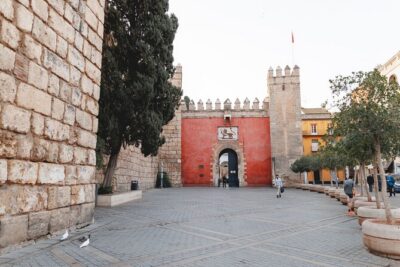 ★ 5.0VIP Guided Seville Alcazar Pre-Opening, Cathedral & Old TownFrom $138191 reviews
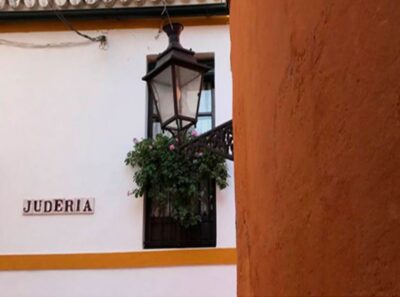 ★ 4.51-Hour Walking Tour Barrio de Santa CruzFrom $18131 reviews
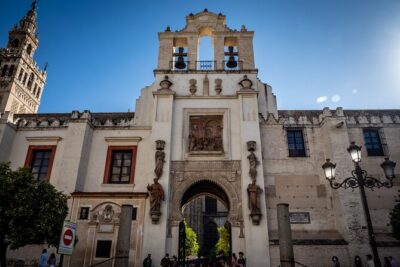 ★ 5.0Private Tour Jewish Quarter, center and Plaza de EspañaFrom $189127 reviews
 ★ 5.0Small Group Jewish Quarter Tour with Tapas & DrinksFrom $59119 reviews
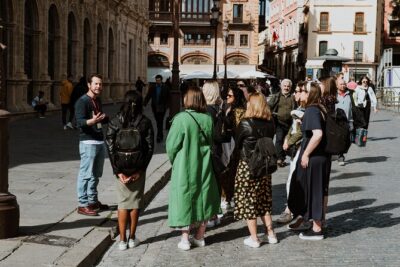 ★ 5.0Seville Former Jewish Quarter Walking Tour: Santa CruzFrom $18105 reviews
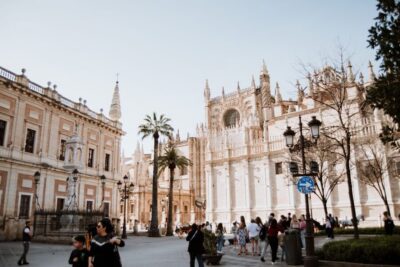 ★ 4.8Seville Jewish Quarter walking tour: Santa Cruz DistrictFrom $15104 reviews
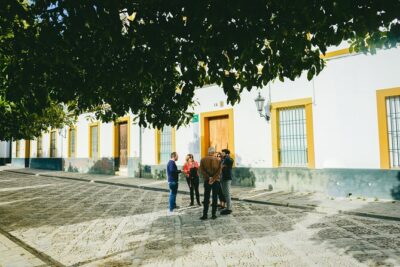 ★ 5.0Seville Jewish Quarter Small-Group Walking Tour: History & GemsFrom $3296 reviews
Continue by place or experience